
Strength training plan for beginners, with a 12-week outline
Published 2026-11-03 · Updated 2026-11-03
A beginner strength training plan is muscle-strengthening on 2 or more days a week, for all the major muscle groups. A working set is 8 to 12 repetitions that are hard to finish. Begin with a weight you can lift comfortably 12 to 15 times. One set of each move is enough for a health benefit. Two or three sets are the step up if you want more of that benefit. A 12-week outline is further down if you want the weeks written out.
Ask your doctor before you begin strength work, and stop a move that hurts. The NHS adult activity guidelines are a public baseline, not a personal clearance.
The NHS asks for strengthening work on at least 2 days a week, plus at least 150 minutes of moderate activity or 75 minutes of vigorous activity. Strength days and a walk can sit in the same week. They are different jobs.
Days, sets and a first weight
Put the strength days on any dates you can keep, with a day between them if you can. Avoid the same muscles two days in a row is the Mayo rule, and it is why a Monday, Wednesday and Friday pattern is common. Two days still meet the public floor. Three days is a full-body week, not a requirement.
For the weight, use the 12 to 15 test on each move. The pair that fits a squat may be heavy for a press. If form breaks, lower the weight or do fewer repetitions. You do not need a tested one-rep max to begin.
ACSM's 2026 update describes strength work as heavier loads, about 80% of a one-rep max, for 2 to 3 sets. That is a later target for people who already know a max. A first home plan uses the repetition test instead. The same update says training the major muscle groups at least twice a week matters more than a complicated split. Home sessions with bands, bodyweight or dumbbells are part of that picture.
A campus recreation sheet, the University of Montana 3-day strength PDF, is a total-body week with gym options and a note to keep the same exercises for several weeks while the load goes up. It is a useful shape. It is a gym sheet rather than a 12-week home file.
Three sets of ten, or five sets of five
People ask whether 3 sets of 10 or 5 sets of 5 is better. They are different schemes, and neither one is the automatic start at home.
A 5 sets of 5 scheme means five sets of five repetitions, usually with a heavier load, about 81 to 87 percent of a one-rep max, and about 4 to 8 minutes of rest between sets. It is the main scheme in some barbell programs, and it is built for compound lifts such as a squat, a bench press, a deadlift, an overhead press and a row. The long rest is there because the load is heavy. A short home session rarely has 4 to 8 minutes to spare between sets.
A 3 sets of 10 scheme means three sets of ten repetitions, usually about 71 to 77 percent of a one-rep max, with about 1 to 3 minutes of rest. The comparison page says this lighter scheme is the usual pick when the training goal is muscle size, and the heavier five-by-five scheme is the usual pick when the goal is maximal strength. Both claims depend on actually using the load the scheme asks for. A light pair done for five sets of five is not the heavy scheme.
That is a difference in training goal. It is not a promise that either scheme will change your body. For a first plan at home, the public range is the clearer start: a weight you can lift about 12 to 15 times, and sets in the 8 to 12 range, on 2 or more days. That sits nearer three sets of ten than five sets of five, and it does not ask you to know a max. How to pick the pair, and when to go up, is in the dumbbell plan for one pair.
Moves to learn before you add load
These are good beginner strength moves. Each line has a start, the movement, and one cue. Use a dumbbell if you have one, or the bodyweight option if you do not. A public photo guide to the same family of moves is on NPR: goblet squat, split squat, row, bench press, deadlift and overhead press.
- Goblet squat. Start standing, feet about shoulder width, weight held at the chest. Sit back and down, then stand. Cue: heels stay down.
- Reverse lunge or split squat. Start with one foot back. Lower straight down, then drive through the front heel. Cue: the front knee tracks over the toes.
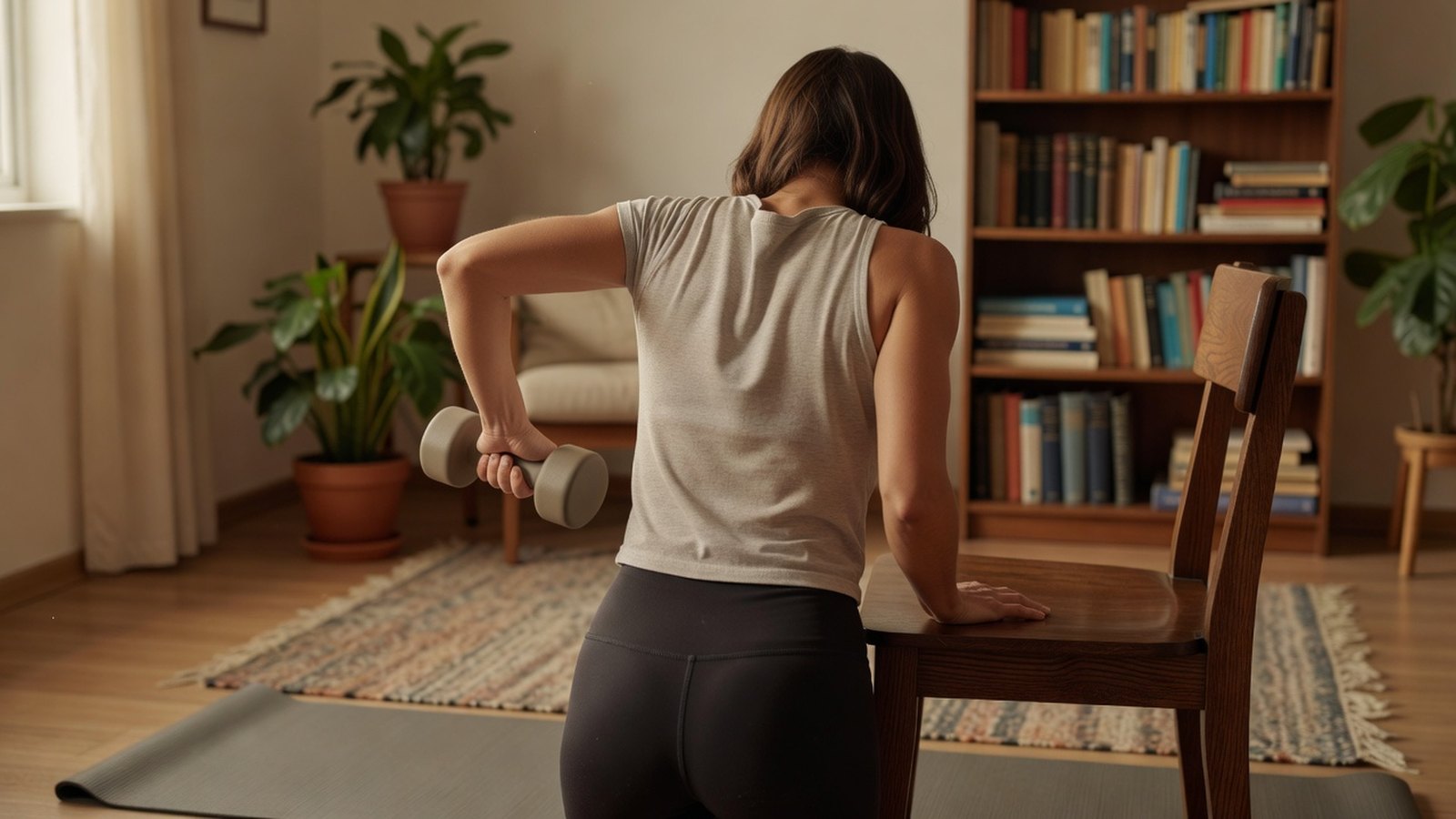
- One-arm row. Start with one hand on a sturdy chair and the other arm long. Pull the elbow back toward the hip, then lower. Cue: the back stays long.
- Floor press, or an incline push-up. Floor press: lie on the mat, dumbbells at the chest, press up. Incline push-up: hands on a wall or a sturdy chair, body in one line, lower the chest and press away. Cue: shoulders stay down.
- Romanian deadlift. Start standing, weights in front of the thighs. Push the hips back and slide the weights down the legs, then stand. Cue: the back stays flat.
- Overhead press. Start standing, weights at the shoulders. Press up, then lower to the shoulders. Cue: ribs stay down.
- Glute bridge. Lie on your back, feet flat. Press through the heels and lift the hips, then lower. Cue: squeeze the seat at the top.
Add a calf raise if you want the lower leg in the same session: rise slowly, pause, lower slowly, with a hand on the chair if you wobble. A bird dog or a dead bug covers the trunk: move slowly, and keep the lower back quiet.
Learn these before you chase a heavier scheme. The cue matters more than the set count in week one. If you want a floor-and-chair start with no pair at all, the calisthenics plan stays on those patterns. How many days to assign is in workout splits.
Twelve weeks on paper (illustrative)
The doses in this outline are illustrative. They match the free sample pages of the 12-week home program: the first session of week 1, week 5 and week 9, plus the week 1 log for the other two sessions. This is a shape you can copy. It is not a promise about your body, and it does not know your joints.
Do three sessions a week, on any days, with a rest day between them if you can. Missed a session? Do the next one when you can.
| Block | Weeks | Rounds | Weight step | What the sample page says |
|---|---|---|---|---|
| Learn | 1 to 4 | 2 | A load you could lift about 15 times | Learn each move with a light weight |
| Build | 5 to 8 | 3 | One step heavier than block 1 | New block, one step heavier, some new moves |
| Step up | 9 to 12 | 3 | One more step, if form stays good | Same idea, one more step |
The sample's own example of one step is 3 kg to 4 kg, or 6 lb to 8 lb. Use that only as a picture of a small jump. If your pair jumps by more than that, stay on the lighter pair and slow the lowering.
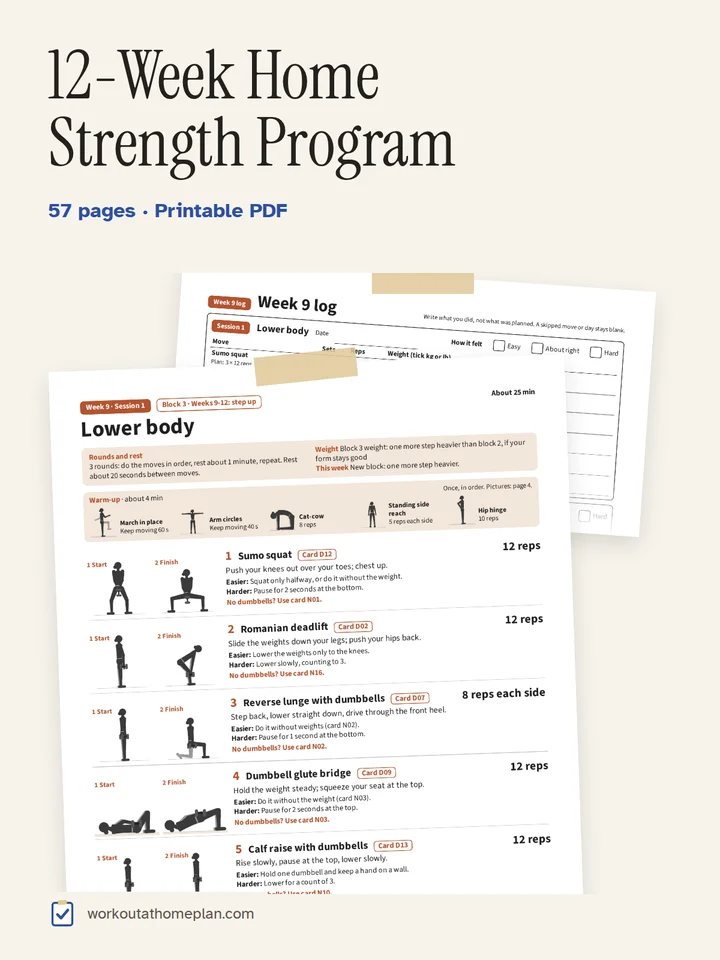
Week 1, session 1, lower body. Goblet squat, Romanian deadlift, reverse lunge, dumbbell glute bridge, calf raise, dumbbell dead bug. The page prints 2 rounds, 12 reps on the bilateral moves and 8 reps each side on the lunge and the dead bug. Rest about 1 minute between rounds and about 20 seconds between moves.
Week 1, session 2, upper body. Floor press, bent-over row, overhead press, lateral raise, biceps curl, and a forearm plank held for 20 seconds. The log prints 2 rounds, 12 reps on the dumbbell moves.
Week 1, session 3, whole body. Squat to press, one-arm row, split squat, calf raise with dumbbells, bird dog. The log prints 2 rounds, 12 reps or 8 reps each side, matching the move.
Week 5, session 1. Still lower body, now 3 rounds, one step heavier. Goblet squat, Romanian deadlift, split squat, sumo squat, and a knee side plank held 30 seconds each side. The reverse lunge has left this page. The split squat and the sumo squat have come in.
Week 9, session 1. 3 rounds, one more step if form stays good. Sumo squat, Romanian deadlift, reverse lunge, dumbbell glute bridge, calf raise with dumbbells. Reps on the page stay at 12, or 8 each side on the lunge.
Warm up the same way each session: march, arm circles, cat-cow, a side reach, and a hip hinge. Cool down with a thigh stretch, a hamstring stretch, child's pose, and a chest opener. If a move hurts, take the easier option printed on that row, or leave the move out today.
The letter file is the 12-week sample. The A4 file is the same sample in A4. Both show those three session pages and one log page. Read them before you copy the outline onto paper.
A program that already steps the weight
The 12-Week Home Strength Program is for keeping going at home after your first month with dumbbell sessions that step up week by week, in three 4-week blocks. Inside are a start page, how to choose your weights, and a warm-up and cool-down page. A bodyweight swap or a no-dumbbell line is on every dumbbell move. Print-only: you write on the pages by hand. Paper sizes are US Letter and A4, in one ZIP. Priced at $39, the 12-Week Home Strength Program is an instant digital download, nothing ships.
Dumbbells are not included. The honest limit of the outline on this page is the same limit as any written plan: it cannot see your form. The printed pages show a start picture and a finish picture for each move, which this article cannot. If you are building the first month before any of that, start with how to make a workout plan or the beginner plan for women at home.
Questions
What are some good strength training exercises for beginners?
Goblet squat, split squat or reverse lunge, one-arm row, floor press or an incline push-up, Romanian deadlift, overhead press and glute bridge. Each one is a real move with a start position, the movement, and one cue in the list above.
Can you provide a sample 12-week workout plan?
Yes. The outline above is a twelve-week shape: three sessions a week, in three blocks, with rounds and load stepping up when the block changes. The free sample PDF shows a session page from the start of each block.
Is 3X10 or 5X5 better?
Neither is better for every beginner. Five sets of five is a heavier barbell scheme with long rests. Three sets of ten uses a lighter load and a shorter rest, and it sits nearer the repetition range public guidance uses for a first muscle-strengthening set. For a first plan at home, start with that public range.
From the shop
12-Week Home Strength Program
Keep going at home after your first month with dumbbell sessions that step up week by week, in three 4-week blocks.
- 12 weeks
- 36 sessions
- dumbbells