
A calisthenics start without a pull-up bar
Published 2026-11-03 · Updated 2026-11-03
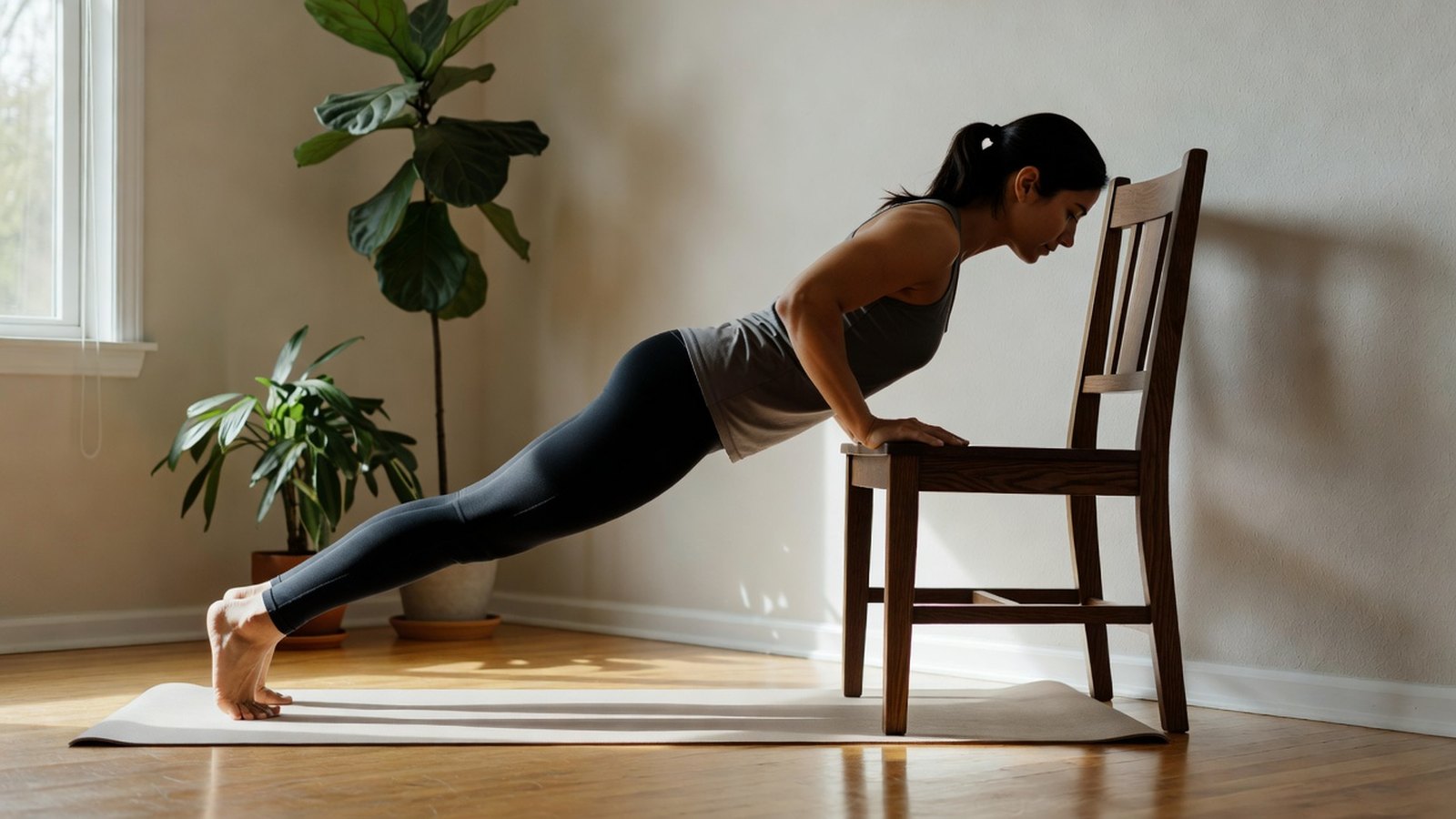
You can start calisthenics at home without a pull-up bar. Classic calisthenics still includes one. A chin-up or pull-up needs something to hang from. The honest start is the floor and a sturdy chair. The bar is a later tool, not the first one.
Harvard Health calls calisthenics strength training that uses your body weight, and says special equipment is optional. The same page lists squats, chin-ups, burpees, and planks as popular moves. The chin-up is the line that needs a bar. A captured guide on ATHLEAN-X treats the pull-up as the main bodyweight move for the lats and says those muscles can be worked with simple pull-up bars. A home calisthenics page from TRX says a chair, a pull-up bar, or a doorway expands your options. Read those together and the start is clear: chair and floor now, bar when you have one and the floor work feels steady.
Before you begin, discuss this program with your doctor. Stop if a move hurts.
What the floor can cover, and what it cannot
A floor-and-chair session can train the patterns people mean when they say "start calisthenics": squat, hinge, push, lunge, and a brace for the core. It cannot train a vertical pull. There is no honest chin-up on a carpet.
That is not a flaw in the start. Harvard Health gives a sample that stays on the floor: a half squat, a kneeling push-up, a side lunge, and a plank with a knee drop, after a knee-lift warm-up. It also says, when you are training for strength, to aim for 8 to 12 repetitions. Beginners can start with one set and work up to three. Rest 30 to 90 seconds between sets. Warm up for 5 to 10 minutes. Those doses are a public starting point. They are not a reason to add a bar in week one.
The weekly frame sits next to that dose. The CDC puts muscle-strengthening on 2 or more days a week, for the legs, hips, back, abdomen, chest, shoulders, and arms. Harvard Health says to keep complete strength workouts to two or three a week and to take a day off in between. Mayo Clinic describes strength sessions of about 20 to 30 minutes. A home calisthenics start can be that: two or three floor sessions in a week, a day off between them, easy walking or marching on the other days so the 150 minutes of moderate activity still has a path. The CDC uses 30 minutes a day, 5 days a week, as one example of that aerobic total, or 75 minutes if the work is vigorous. Floor strength is the muscle-strengthening part, not a replacement for every easy walk.
Floor-and-chair moves, with one cue each
Use a chair that does not slide. A seat against a wall is steadier than a chair on a rug.
Chair-touch squat. Start standing, feet about hip-width, chair behind you. Lower your hips back until they brush the seat, then stand up. Cue: heels down. This is the beginner squat. A deeper squat can wait.
Incline push-up on the chair. Start with your hands on the seat, feet back, body in one line from head to heels. Bend your elbows and lower your chest toward the seat, then press back. Cue: hips stay in that line. Easier: hands on the wall. Harder: a lower surface, only if it is stable.
Glute bridge. Lie face up, knees bent, both feet on the floor. Drive through your heels to raise the hips, then come back down. Cue: squeeze your seat, do not crank your neck. This is the hinge pattern when you do not have a bar or a weight.
Reverse lunge, hand on the chair. Start standing, one hand on the chair back. Step back, lower a little, push through the front heel to stand. Cue: short step. Both sides.
Bird dog. Start on hands and knees. Reach the opposite arm and leg, then switch. Cue: hips level. This is back and core work without a hang.
Side-lying leg raise. Start on your side, head supported, legs long. Lift the top leg a little, heel leading, then lower. Cue: do not roll onto your back. Both sides.
Skip burpees at the start. Harvard lists them as a popular move. They are a jump plus a push-up. They are not required for a first month on the floor.
If you want the same shapes inside a no-equipment week, the home plan with no equipment separates easy days from strength days. The simple 30-minute routine is the clock version of a full-body session.
Four weeks on the floor (illustrative)
This progression is illustrative. It is a sample order, not a test you pass. Stay on a week until the moves feel steady. A missed day does not erase the week.
- Week 1: one set of each floor move, inside about the strength length you can finish calmly. Learn the cue. Stop the set while you still have a rep in reserve.
- Week 2: two sets, with a rest between them. Same moves. Do not add a jump.
- Week 3: slow the lowering on the squat, the push-up, and the lunge. The shape stays the same.
- Week 4: pick one harder option only, such as a lower push-up surface or a slightly deeper chair squat. Leave the other moves as they were.
The bar is not in this month. If you already own one, you still do not have to use it yet. The plan below stays on the floor and a chair for the whole month.
When a bar is actually the next step
A floor-and-chair month has no hanging pull in it. Learning one is a separate step that needs a bar or a sturdy doorway setup that will not move, and the first pull is not a full chin-up from a dead hang. A common regression is a body row under a low bar, or a band row, which is no longer "no equipment."
Until that day, your back work is the bird dog, the bridge, and the habit of standing tall. That is incomplete compared with a pull-up. Say so, and keep training. The strength plan for beginners is the page if you later add dumbbells. This page stays with body weight.
Harvard Health also says to build up gradually and to work in a range that feels comfortable. That is the rule for the four weeks above. Do not lock your elbows or knees hard at the end of a push or a squat. Leave a small bend.
Cards for the shapes, not a bar course
If you want the moves as pictures you can hold, the No-Equipment Exercise Cards let you see each move clearly at your own pace and build a session from cards, without video. The No-Equipment Exercise Cards include large Start and Finish pictures, a cue, and an easier and a harder option. The No-Equipment Exercise Cards are an instant digital download at $6.50, and nothing ships.
These cards are not a pull-up course and not a bar program. They are floor and bodyweight shapes. Use them as the picture for the moves on this page. The written month, if you want sessions already ordered, is a different file: see how to make a workout plan before you buy a longer plan, and the free home workout plan page if you want a free start first.
Questions
Do I need a pull-up bar to start calisthenics?
No. You can start with squats, a bridge, an incline push-up, a lunge, and a bird dog. A chin-up does need something to hang from. Harvard Health lists chin-ups among popular calisthenics moves, and also says special equipment is optional. Both lines are true: the floor start needs no bar, and the classic pull does.
How many strength days should a beginner plan?
Muscle-strengthening belongs on 2 or more days each week in the CDC adult guidelines. Harvard Health says to keep complete strength workouts to two or three a week and to take a day off in between. About 20 to 30 minutes is the strength length Mayo Clinic describes.
What can I do with a floor and a chair?
A chair-touch squat, a push-up with your hands on the chair seat, a reverse lunge with one hand on the chair, a glute bridge, a bird dog, and a side-lying leg raise. Learn one set before you add another.
From the shop
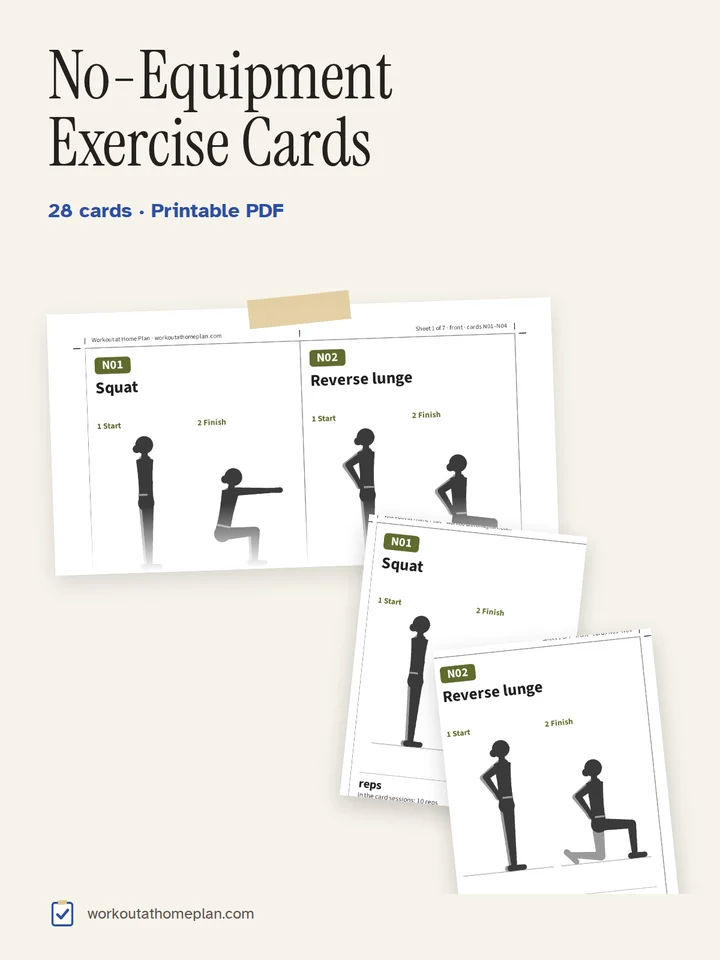
No-Equipment Exercise Cards
See each move clearly at your own pace and build a session from cards, without video.
- 28 cards
- no equipment