
Workout splits explained
Published 2026-11-03 · Updated 2026-11-03
Match the split to the days you will train. Two days: full body each time. Three days at home: full body each time. Four days: upper body and lower body, alternating. A one-muscle-group gym week needs more days than most home weeks have. Adults still need the public totals around that choice: at least 150 minutes of moderate-intensity activity a week, and muscle-strengthening on 2 or more days for the legs, hips, back, abdomen, chest, shoulders, and arms.
Check with your doctor before you copy a split, and stop a move that hurts, as Mayo Clinic advises when a strength exercise causes pain.
Pick by days, not by hype
A split is only a way to divide the week's strength work. It is not a personality. If you can train twice, each session should cover the body, or you will wait too long to train a group you skipped. ACE says that if you train two days a week, do a full-body routine, with a squat pattern and an upper-body push among the moves.
If you can train three days, home training still favors full body. Ladies Who Lift says that if you train 3 or fewer days each week, you should train full body, so a missed day still leaves the major groups trained. A gym guide can disagree at the third day. ACE groups three to four days as a lower-body and upper-body split. Both can be argued. For a home beginner, full body on three days is the simpler week, because each page still has legs, a push, and a back or core move.
Four days is where upper and lower earns the extra trip to the mat. You can give the lower body its own day and the upper body its own day, twice each, and still rest. ACE's three-to-four-day note points that way, and a beginner-split page lists an upper and lower week at four days. Leave at least a day before you repeat the same half, in the spirit of resting a full day before you work the same muscles again.
A days-to-split table
Read the first column as the days you will keep, not the days you hope for.
| Days | Split that fits a home week |
|---|---|
| 2 | Full body each session |
| 3 | Full body each session at home; some gym notes switch to upper and lower here |
| 4 | Upper body and lower body, alternating |
Write the split on the same page as the days, in pencil. If a midweek session disappears for a couple of weeks running, the split is the thing to change. A full-body page you do beats an upper-body page you keep postponing.
Name the pattern, not a mood. Legs and core is a pattern. Waiting to see how you feel is not a plan. A home full-body day can be a squat or a sit-to-stand, a hinge, a push, a back move, and a core brace. That is enough. The gym body-part week is for someone who already trains often enough to give chest its own day.
The aerobic minutes still sit around the strength days. Walks on the open days are how a three-day strength week moves toward 150 minutes. Some physical activity is better than none if the week comes out smaller.
One open result groups beginner splits into 7 options. That count is a menu of types. It is not a schedule.
One gym week, muscle by muscle
An athlete-style gym split is a week that assigns muscle groups to days, the way a gym program does, rather than mixing the whole body every time. Peloton's sample body-part week is a concrete example:
- Monday: legs
- Tuesday: arms and shoulders
- Wednesday: cardio or recovery
- Thursday: back
- Friday: chest
- Saturday: cardio
- Sunday: rest
Push, pull, and legs is another gym pattern on that same page: a push day for chest, shoulders, and triceps, a pull day for back and biceps, and a leg day for the lower body. Both are gym shapes. They assume you will show up often enough that chest is not missing for a fortnight because Wednesday was busy.
Use that example when someone asks what an athlete gym split looks like. Do not copy it onto a two-day home week. The home version of "split" at two or three days is which pattern leads the page, not which muscle is the only one allowed to work.
If you are building the week from scratch, the steps are in how to make a workout plan. A first month already written for home is the beginner plan.
The home rotation
The printed home month does not use a chest day and a back day. The free starter names its three sessions: Legs and core, then Upper body and back, then Whole body. Print the letter starter or the A4 starter and you can see the first pass. The rest of that month sheet keeps the same three names in the same order.
That is a themed rotation, not a body-part split and not full body on every page. Legs and core holds the squat pattern and the bridge. Upper body and back holds the push and the back moves. Whole body mixes both. It is one way to lay out three home days; the full-body pages described above are another.
A squat on a legs page starts standing. Sit the hips back and down, then stand, heels down. A push on an upper-body page can start with hands on a counter, body in one line, elbows bending and pressing back. A hinge on a whole-body page starts standing, hips pushing back, back flat, then you stand tall again.
Rest a day between these sessions if you can. The themes overlap, so the muscles are not fully fresh just because the title changed.
A plan that already chose the days
You can draw the table above on paper and buy nothing. The honest limit is that a split chart does not list today's moves, and you still have to do the session.
When you want three home sessions a week already named, the 4-Week Home Workout Plan lists the month with tick boxes, and each session sheet names a warm-up, the moves, and a cool-down. Each move has Start and Finish pictures. It is print-only, with no video, no coach and no app. The 4-Week Home Workout Plan is $8.99. It is an instant digital download, and nothing ships. A printer, paper, a pen, and space for a mat are what you need. Dumbbells are optional.
If four days of upper and lower is the week you already keep, and you want that pattern with dumbbells for a longer block, the later step is the strength plan for beginners, not a longer bro split taped to the fridge.
Questions
What is an example of an athlete gym split?
An athlete-style gym split gives each lifting day its own muscle groups, instead of one mixed home session. Peloton's sample body-part week is a concrete example: Monday legs, Tuesday arms and shoulders, Wednesday cardio or recovery, Thursday back, Friday chest, Saturday cardio, Sunday rest. That is a gym week. At home, with two or three days, a full-body session fits better, because a missed chest day would mean no pushing work that week.
What muscle groups should you split?
Split the major groups the CDC names for muscle-strengthening: legs, hips, back, abdomen, chest, shoulders, and arms. A gym split may put legs on one day and chest on another. A home week with few days can touch several of those groups in each session, so a missed day still leaves the others trained.
What is the best workout split?
There is no single split for every week. The fit is the days you will train. Two days points to full body. Three days at home also points to full body. Four days can be upper body and lower body, alternating. A split you skip is a worse fit than a plain week you keep.
What are the 7 days of gym?
There is no official list of 7 required gym days. A week has Monday through Sunday, and one gym sample fills them as legs, arms and shoulders, cardio or recovery, back, chest, cardio, and rest. The CDC asks for muscle-strengthening on 2 or more days, not on all 7. One open result groups beginner splits into 7 options, which is a count of split types, not a rule that you must train every day.
From the shop
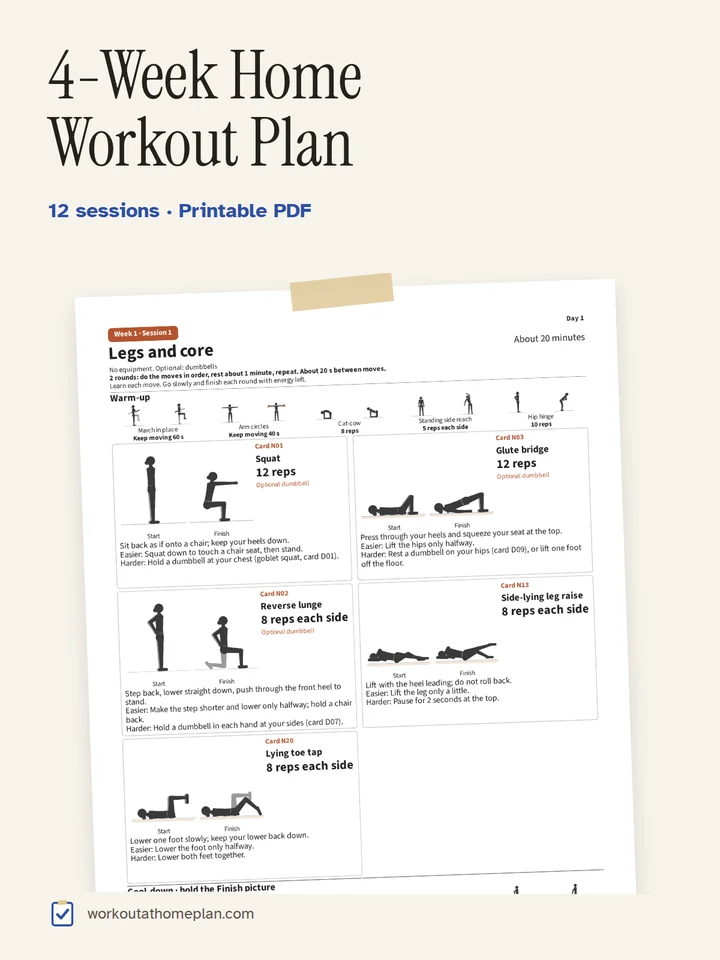
4-Week Home Workout Plan
Know exactly what to do at home for your first month: three sessions a week of about 20–30 minutes, every move pictured.
- 4 weeks
- 3 sessions a week
- about 20–30 min
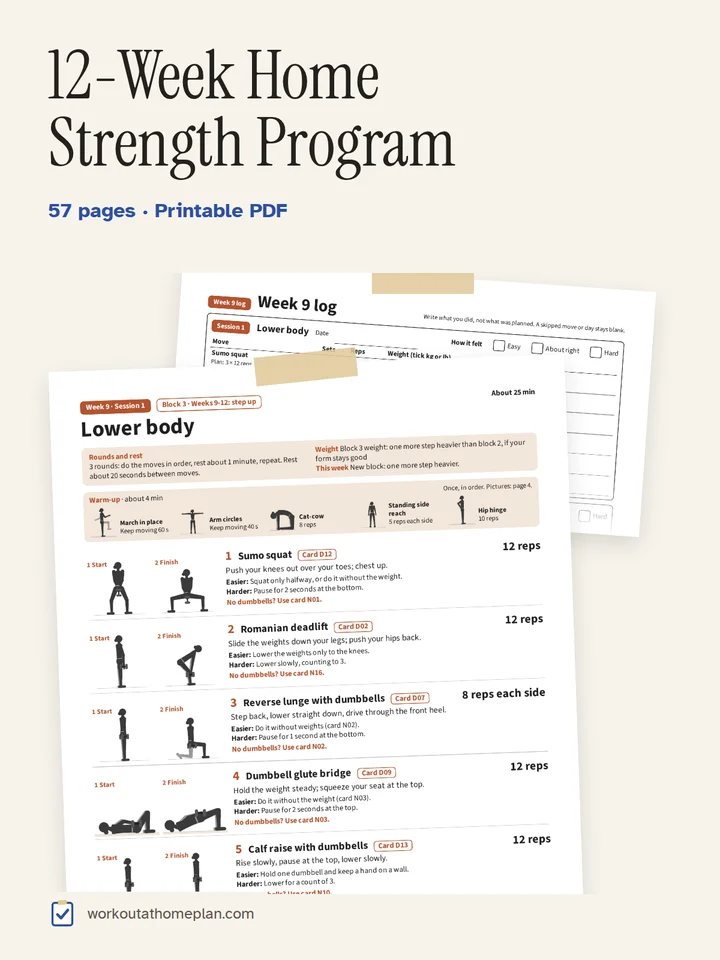
12-Week Home Strength Program
Keep going at home after your first month with dumbbell sessions that step up week by week, in three 4-week blocks.
- 12 weeks
- 36 sessions
- dumbbells