
Dumbbell workout plan at home with one pair
Published 2026-11-03 · Updated 2026-11-03
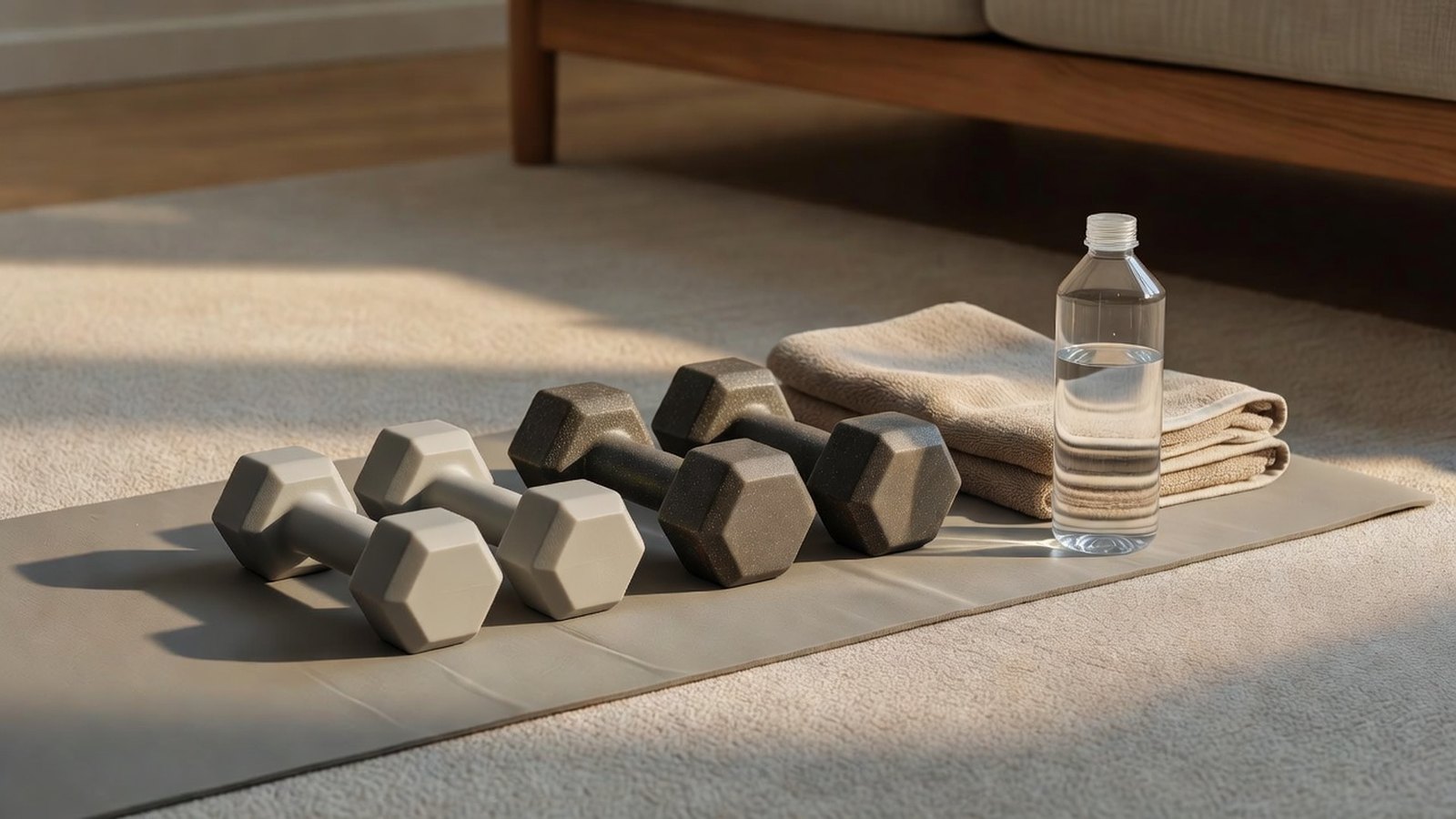
A simple dumbbell workout plan at home uses one pair on 2 or more days a week, and it works the major muscle groups. Choose a weight heavy enough to tire those muscles after about 12 to 15 repetitions. Go up when you can easily do more repetitions, and increase the weight gradually. That is the plan. The week further down is one way to use it.
Before the first dumbbell session, check with your doctor, and stop if a move hurts. The CDC adult activity page is general guidance, not a personal plan.
Alongside the dumbbell days, adults need at least 150 minutes of moderate activity a week, or 75 minutes of vigorous activity. A walk on the days between sessions can cover that part. The dumbbell work is the muscle-strengthening part, on 2 or more days, not a replacement for the walk.
Pick a starting weight
Start with a weight you can lift comfortably 12 to 15 times. The last few repetitions should feel hard. The first few should still look like the move you meant to do.
Use the same test on each move. A goblet squat and an overhead press will not agree on one number. The pair that is right for a row may be heavy for a press. If you own one pair, let the harder move stop when form slips, and keep going on the easier move.
If you are not able to keep good form, lower the weight or the number of repetitions. Form is the brake. A pair that makes you lean, shrug, or bounce is too heavy for that move today.
A set counts when it is hard to do another repetition. Public guidance treats 8 to 12 repetitions as one set, and says at least one set helps, with two or three sets if you want more of the benefit. The 12 to 15 test is how you pick the pair. The 8 to 12 range is how you know a working set counted. If the pair is a bit light, stay nearer 12 to 15. If it is a bit heavy, stop nearer 8, as long as the shape of the move stays tidy.
You do not need a one-rep max to start. You need a pair you can lift for that many repetitions, a mat, and a sturdy chair for the row. How three sets of ten compare with five sets of five is a separate question, and it matters more once you already know the lifts.
When the pair should go up
Go up when you can easily do more repetitions of a move than you could when you chose the weight. Increase the weight gradually, and keep the same technique. If the new pair makes the reps ugly, go back down for that move.
Leave a day before you train the same muscles again. Avoid the same muscles two days in a row. A full-body day, a rest day, then another full-body day fits a one-pair week. Two or three full-body days in a week is enough for a start. You do not need a four-day or six-day split to begin.
The honest limit of a one-pair plan is the jump. A rack lets you add a small amount. One pair often jumps by a lot. When the current pair is easy at the top of the range, and the next pair you could buy is much heavier, stay on this pair and slow the lowering, or pause for a breath at the hard point. Buy the heavier pair when you can still finish the repetitions with the same form. Until then, the lighter pair is the right one.
Write the weight and the repetitions down after the session. Next week you will not remember which move felt easy. A pen on the page is enough. An app is optional, and it is not required for this plan.
One pair, three days (illustrative)
The doses in this week are illustrative. They are a sample you can follow with one pair. They are not a medical prescription, and they are not the printed program. Use the 12 to 15 test above to decide if your pair belongs in the session. Rest about 45 seconds between moves and about 1 minute between rounds. Do the days on any dates you like, with a day between them if you can. Warm up with an easy march, arm circles, and a few hip hinges before the first move. Cool down with a gentle thigh stretch and a chest opener.
If a move feels wrong, take the easier option on that row and leave the harder one for another week.
Day A, full body. The doses below are illustrative.
| Move | Dose | How |
|---|---|---|
| Goblet squat | 10 reps, 2 rounds | Hold the dumbbell at your chest and sit back. Heels stay down. Easier: tap a chair seat, then stand. |
| Romanian deadlift | 10 reps, 2 rounds | Push your hips back and slide the weights down your legs. Back stays flat. Easier: stop at the knees. |
| Floor press | 10 reps, 2 rounds | Lie on the mat, dumbbells at the chest, press up. Shoulders stay down. Easier: press one arm at a time. |
| One-arm row | 8 reps each side, 2 rounds | One hand on a sturdy chair, pull the elbow toward the hip. Back stays long. Easier: do the row with no weight to learn the path, then add the dumbbell. |
| Glute bridge | 10 reps, 2 rounds | Feet flat, press through the heels, squeeze the seat at the top. Easier: lift the hips only halfway. |
Day B, full body. Still the illustrative week.
| Move | Dose | How |
|---|---|---|
| Reverse lunge | 8 reps each side, 2 rounds | Step back, lower straight down, drive through the front heel. Easier: shorter step, hold a chair. |
| Overhead press | 8 reps, 2 rounds | Weights at the shoulders, press up, ribs stay down. Easier: press one arm at a time. |
| Split squat | 8 reps each side, 2 rounds | Drop straight down. Feet stay where they started. Easier: lower only halfway. |
| Bent-over row | 10 reps, 2 rounds | Hinge, back flat, pull both dumbbells toward the hips. Easier: one arm, other hand on the chair. |
| Calf raise | 12 reps, 2 rounds | Rise slowly, pause, then lower with control. A hand on the chair is fine. |
Day C, full body. Still the illustrative week.
| Move | Dose | How |
|---|---|---|
| Squat to press | 8 reps, 2 rounds | Squat, then press the dumbbells as you stand. Easier: squat only, press on a separate breath. |
| Hip hinge | 10 reps, 2 rounds | Push the hips back, back flat, weights stay close to the legs. Easier: a smaller tip forward. |
| Incline push-up | 8 reps, 2 rounds | Hands on the chair seat, body in one line, lower the chest and press away. Easier: hands on a wall. |
| One-arm row | 8 reps each side, 2 rounds | Same chair setup as day A. Pull toward the hip, then lower with control. |
| Dead bug | 8 reps each side, 2 rounds | Lie on your back, lower one foot slowly, lower back stays down. Easier: a smaller lower. |
Missed a day? Do the next day on the list when you can. Nothing is lost. If the whole week was a scramble, repeat day A next week rather than inventing a new list.
What this week will not decide
This week will not tell you a one-rep max, and it will not pick a four-day split. It answers the home question: which moves, which pair, and when to go up. A video plan can show the moves in motion. A gym plan can assume a rack and a bench. This page assumes a mat, a chair, and the pair you already have.
If you want the bodyweight version first, the home plan with no equipment is the other door. A shorter home routine is there if this week feels long. How the days of the week fit together is in workout splits.
If you want the weeks already written
After a first month, the 12-Week Home Strength Program keeps you going at home with dumbbell sessions that step up week by week, in three 4-week blocks. It holds a start page, how to choose your weights, 36 session pages and 12 weekly log pages. Dumbbells are not included. Moves are shown as still pictures with written cues. There is no video, no coach and no app. The 12-Week Home Strength Program is an instant digital download, nothing ships, at $39.
The free sample of that file shows how a session page is laid out, including the starting-weight note and the later block pages. Open the letter sample or the A4 sample and read the weight line before you decide.
If you are still on bodyweight, start with the beginner plan for women at home and come back to the pair when the moves feel familiar.
Questions
How heavy should my first dumbbells be?
Heavy enough that the working muscles tire after about 12 to 15 repetitions, and light enough that your form still holds. If the last reps fall apart, the pair is too heavy for that move.
When should I increase the dumbbell weight?
When you can easily do more repetitions of that move than the range you started with, and your form still looks the same. Add weight gradually. If you only own one pair, slow the lowering before you buy a much heavier pair.
Can I follow a dumbbell plan with only one pair?
Yes. Use the same pair for every move, and let the harder moves stop sooner. A rack of many pairs makes smaller jumps. One pair still works if you change reps or tempo before you change the weight.
From the shop
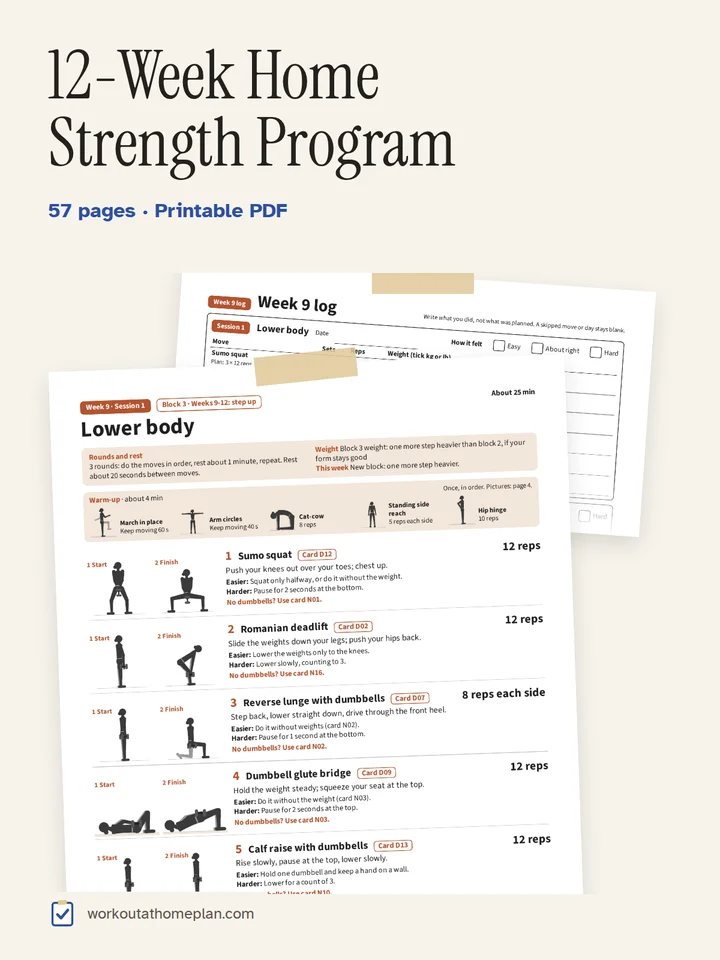
12-Week Home Strength Program
Keep going at home after your first month with dumbbell sessions that step up week by week, in three 4-week blocks.
- 12 weeks
- 36 sessions
- dumbbells