
How to make a workout plan you will follow
Published 2026-11-03 · Updated 2026-11-03
Make the plan from the weekly totals, then write one week you will actually keep. For substantial health benefits, adults should do at least 150 minutes (2 hours and 30 minutes) to 300 minutes (5 hours) a week of moderate-intensity aerobic activity, or 75 minutes (1 hour and 15 minutes) to 150 minutes (2 hours and 30 minutes) a week of vigorous-intensity activity, or a mix. Preferably, that aerobic activity is spread throughout the week. Also do muscle-strengthening activities of moderate or greater intensity that involve all major muscle groups on 2 or more days a week. A plan you will follow is those totals, placed on days you already have, with the moves written down before you start.
Check with your doctor before a new plan, and stop if anything hurts; the totals on this page follow the CDC adult activity overview and the HHS executive summary, which are general guidance, not a personal prescription.
Weekly totals, then your days
Write two lines at the top of the page before you pick a single move.
Line one is aerobic work. The CDC states the same floor in plainer clothes: at least 150 minutes of moderate-intensity activity a week, such as 30 minutes a day, 5 days a week, or 75 minutes of vigorous-intensity activity. The HHS top-line page puts the moderate range at 150 to 300 minutes a week, with brisk walking or fast dancing as examples, and muscle-strengthening, such as lifting or push-ups, on at least 2 days.
Line two is strengthening. The major groups named by the CDC are the legs, hips, back, abdomen, chest, shoulders, and arms. If a session never touches one of those, the week is not finished just because you felt busy.
The NHS asks adults to spread exercise evenly over 4 to 5 days a week, or every day, alongside at least 150 minutes of moderate activity or 75 minutes of vigorous activity, and strengthening on at least 2 days. The U.S. guideline says "preferably spread throughout the week" and gives a 5-day example. They agree on the weekly totals. The days themselves stay yours to choose. Use the version that matches the days you can protect.
Some physical activity is better than none. A smaller week that you finish beats a crowded grid you abandon on day two.
Five steps to a week you keep
Step 1. Copy the totals onto paper. 150 minutes moderate, or 75 minutes vigorous, or a mix, plus strengthening on 2 or more days. Leave a blank for the days you will use.
Step 2. Circle only the days you can keep in an ordinary week. Commute, dinner, and the evening you already give to something else. A plan that needs a free life will not be followed.
Step 3. Give each circled strength day a job that covers the major groups if you have only a few days. With three strength days, make each one full body: a squat or sit-to-stand, a hinge or bridge, a push, a pull or a back raise, and a core brace. With more days, you can split upper and lower. The map for that choice is in workout splits explained.
Step 4. Write the easier option next to each move, and the missed-day rule at the top. Next session when you can. A day off between strength days. Walks can sit on the other days and count toward the minutes.
Step 5. Put the page where you will see it before you decide you are too tired. A kitchen table, a clipboard, the wall by the mat. If the plan lives in a note you never open, it is not a plan yet. For paper, an app, or a wearable as the place you keep score, see paper or an app.
That is the whole method. The moves can be simple. The week has to be specific.
Two rest days, and three sessions
Two rest days is not too much. The CDC example is 30 minutes a day, 5 days a week. That pattern has two days with no planned session. Muscle-strengthening on 2 or more days is the strengthening floor, so a week with two full days off still has room to meet it.
Three sessions can be enough, and sometimes they are not, depending on the clock. Three longer moderate sessions can clear 150 minutes when those minutes add up. Three short strength sessions may cover the strengthening days and still leave the aerobic total short. Add walks. The HHS summary wants the aerobic work spread through the week, and the NHS would rather see exercise on 4 to 5 days or daily. Neither line says a beginner must train seven days to count.
If your real life is three evenings, write three strength sessions and two or three walks, and call that the plan. If your real life is five short walks and two strength days, write that. The mistake is copying a six-day gym grid you will not keep. A beginner home start is written out in the beginner plan for women at home. A week you can print and follow for free is in the free home workout plan.
A filled week (illustrative)
This grid is an illustration, not a prescription. Shift the days to match your calendar. "Brisk" means a pace where you can talk, but not sing, the CDC's rule of thumb for moderate activity.
| Day | What is written down |
|---|---|
| Mon | Strength, full body, about 25 minutes; brisk walk, about 30 minutes |
| Tue | Brisk walk, about 30 minutes |
| Wed | Rest from strength; brisk walk, about 30 minutes |
| Thu | Strength, full body, about 25 minutes; brisk walk, about 30 minutes |
| Fri | Off |
| Sat | Strength, full body, about 25 minutes; brisk walk, about 30 minutes |
| Sun | Off |
On a strength day the page lists five moves, in order, with an easier option: squat to a chair, hands-on-counter push-up, hip hinge with a flat back, bird dog with one limb if both is too much, and a dead-bug or a forearm plank on the knees. One pass through, then a second pass if you still have easy form. Cool down with a slow stretch you can hold while you breathe.
Five brisk walks of about 30 minutes make 150 moderate minutes; the strength sessions are counted separately, the way the guidelines count them. If your week has fewer walks, it is a smaller starting week. The walks do not need a special outfit. They need a time you already walk, made a little longer.
A printed plan, after the week is clear
You can make this week on any blank sheet. The honest limit is that a method still leaves the writing to you, and a written week does not do the session.
If you want the first month already laid out, session by session, the 4-Week Home Workout Plan holds 12 session pages, each session on its own sheet, with a warm-up, 5 or 6 moves with a start picture and a finish picture, and a cool-down. It needs a printer, paper, a pen, and space for a mat. Dumbbells are optional. The 4-Week Home Workout Plan is $8.99, an instant digital download, and nothing ships. It is print-only, and you write on each page by hand. It includes no video, no coach, and no app.
The free sample of that plan is the 3-day letter starter and the A4 starter. Use it to see the page shape before you decide.
Questions
Is 2 rest days in a week too much?
No. Two rest days in a week is not too much. The CDC example of the aerobic guideline is 30 minutes a day, 5 days a week, which leaves two days off. Muscle-strengthening is 2 or more days a week, not a daily assignment. A day off is part of a week you can repeat.
How to find a workout routine?
Start from the weekly totals, then pick a routine that matches the days you will keep. A full-body home routine, three times a week, is a sound start if that is your real schedule. Look for moves you can picture, an easier option, and a place to tick the day. A gym sheet or an app is another path if you will actually open it.
Is exercising 3 times a week enough?
It can be enough for muscle-strengthening, which the guidelines set at 2 or more days a week working all major muscle groups. For the aerobic total, 3 sessions are enough when the minutes add up to at least 150 minutes of moderate activity in the week. CDC Example 3 is a mix of moderate and vigorous activity on 2 or more days, so the guideline is a weekly total, not a fixed session count. If the three sessions are short, add brisk walks or other activity on other days; light movement only counts toward the moderate total at a pace where you can talk, but not sing.
From the shop
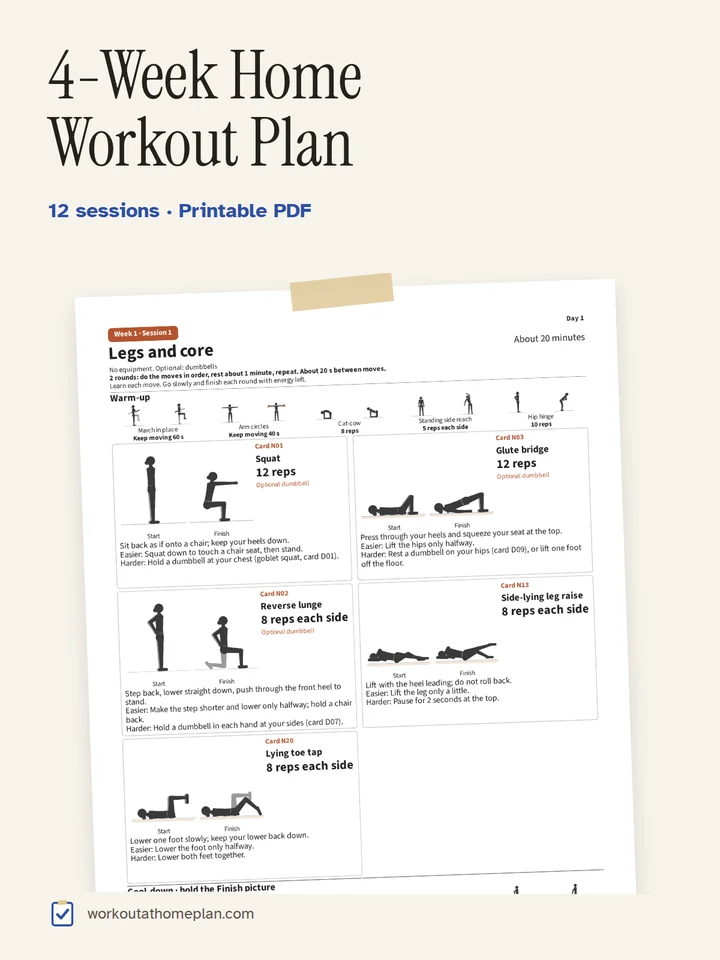
4-Week Home Workout Plan
Know exactly what to do at home for your first month: three sessions a week of about 20–30 minutes, every move pictured.
- 4 weeks
- 3 sessions a week
- about 20–30 min
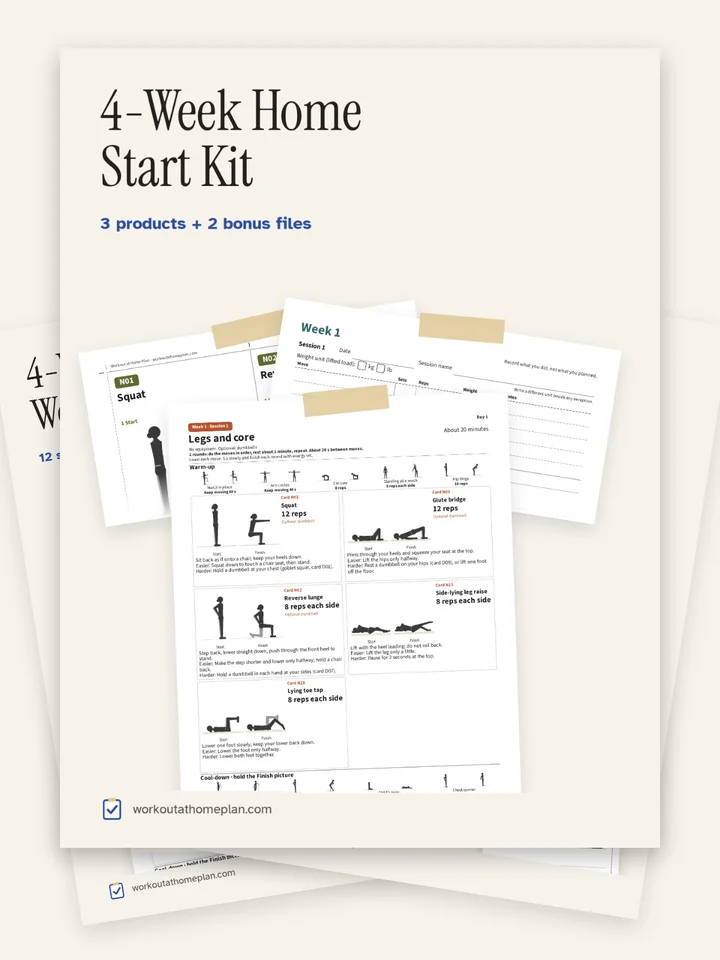
4-Week Home Start Kit
Your first month at home, planned day by day, with every move shown.
- 4-Week Home Workout Plan$8.99 on its own
- Home Workout Tracker$4.99 on its own
- No-Equipment Exercise Cards$6.50 on its own
- 2 bonus files: quick start, 4-week wall calendar
Price: $11.49
The three products bought one by one on this shop: $20.48. You save $8.99
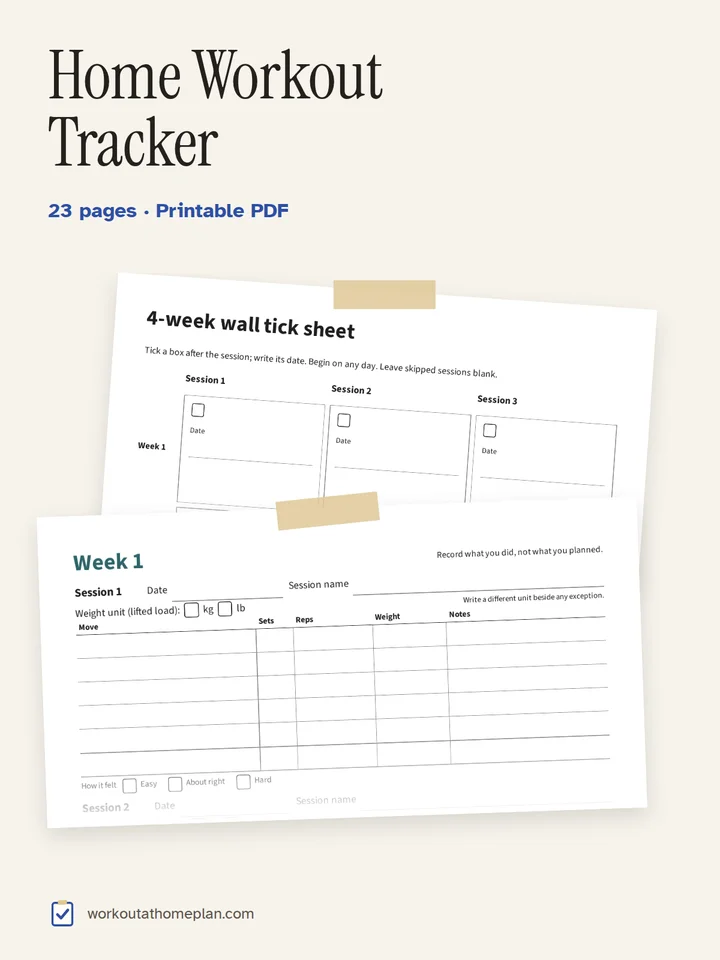
Home Workout Tracker
Write down every home workout you do, ours or your own, and see where you are at a glance.
- 16 week pages
- print and write