
A simple 30-minute home workout routine
Published 2026-11-03 · Updated 2026-11-03
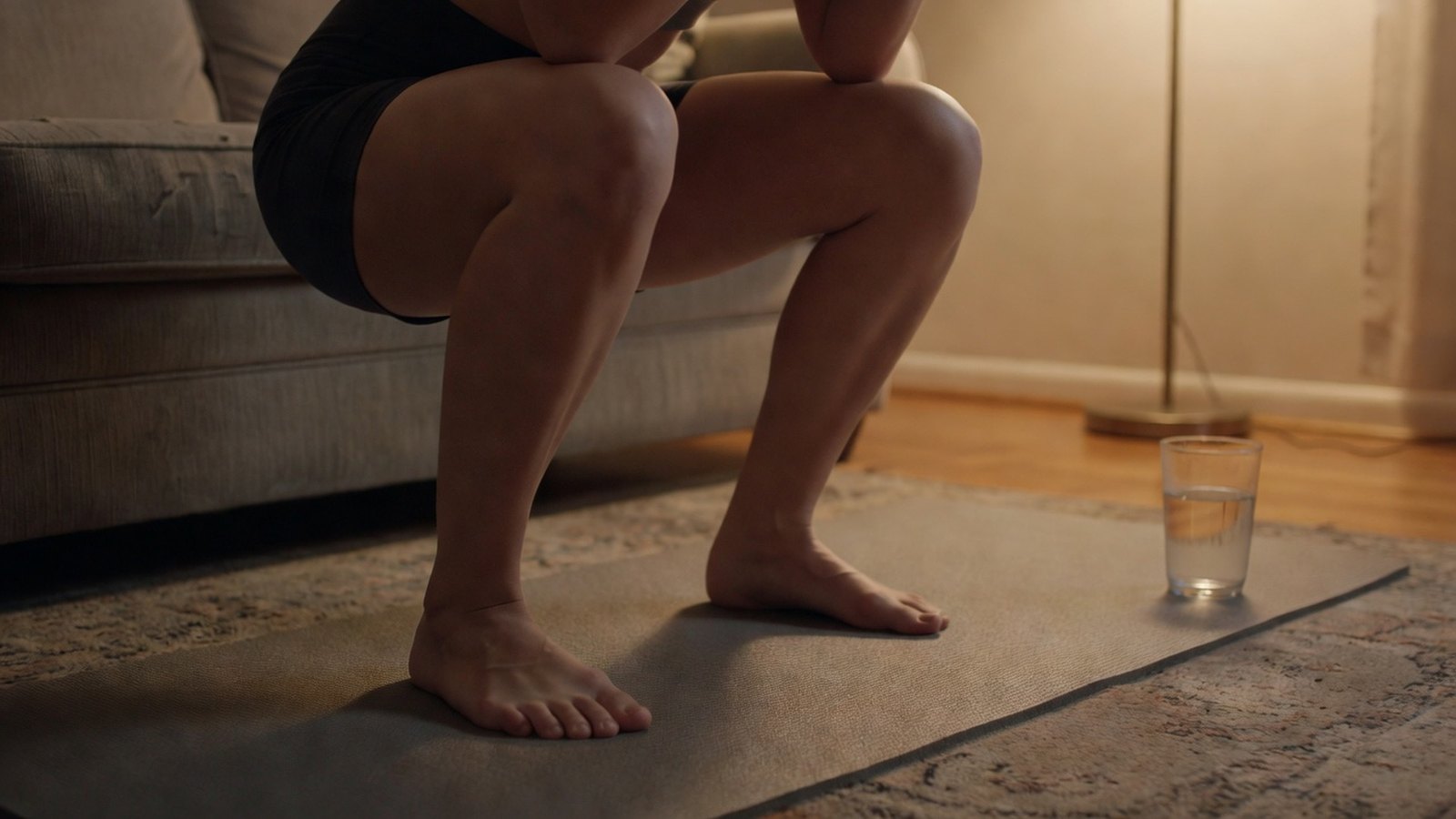
A useful home workout routine is a full-body session of about 30 minutes. That length is not a gym rule. It is the example in the CDC adult activity guidelines: 30 minutes a day, 5 days a week, as one way to reach 150 minutes of moderate-intensity activity. Strength work can be shorter still. Mayo Clinic says you may notice stronger muscles with strength training at least two times a week for about 20 to 30 minutes each time.
Before starting any new exercise program, discuss your plans with your doctor, and stop if a move hurts.
How long a gym workout should be
There is no required gym length in the adult guidelines. The weekly totals are what the pages set.
The CDC says adults need at least 150 minutes of moderate-intensity activity a week. The same total can be 75 minutes of vigorous activity, or a mix of the two. Muscle-strengthening work is separate: 2 or more days a week for the major muscle groups (legs, hips, back, abdomen, chest, shoulders, and arms). The CDC also says you can spread the 150 minutes through the week. You can spread it through the week and break it into smaller chunks. The 30-minute day is an example, not a minimum session.
Mayo Clinic restates the same weekly aerobic totals and adds a practical strength dose: exercises for all major muscle groups at least two times a week, about 20 to 30 minutes each time. One set of each exercise is enough for health and fitness benefits, using a resistance that tires the muscles after about 12 to 15 repetitions. Mayo also says to aim to exercise most days of the week for the aerobic part. That is walking, marching, or anything that gets you moving, not a second heavy strength session.
A gym visit and a living-room session are the same kind of time. If the gym day runs long because of the walk to the machine and the wait for a bench, that extra time is not a requirement. At home, the clock starts when you start the warm-up. The routine below is a strength session, so its time on the mat is not the same as the CDC's moderate aerobic minutes, which count only at a pace where you can talk, but not sing. Two or three of those sessions can hold the strength work Mayo describes, and on other days a brisk walk or march at that talk-test pace adds the aerobic minutes.
If you want the week drawn out as days rather than one session, the guide on workout splits is the next page. This page stays with one simple routine.
Full-body moves that belong in the routine
A full-body home session needs a push, a squat or lunge, a hip lift, and something for the back and core. You do not need a machine for that. These are the moves. Each one has a start, the movement, and one cue.
Squat. Start standing, feet about hip-width, toes pointing forward. Sit your hips back and bend your knees, then stand. Cue: keep your heels down. Easier: touch a chair seat with your hips and stand back up. Harder: pause at the bottom, still with the heels down.
Glute bridge. Start on your back, knees bent, feet flat, arms by your sides. Press through your heels and lift your hips, then lower. Cue: squeeze your seat at the top and keep your neck quiet. Easier: lift only halfway. Harder: hold the top for a breath.
Incline push-up. Start with your hands on a sturdy chair seat or on the wall, body in one line from head to heels. Bend your elbows and bring your chest toward your hands, then press back. Cue: do not let your hips sag. Easier: hands higher, on the wall. Harder: hands lower, on a stable chair seat against a wall.
Reverse lunge. Start standing. Step one foot back, lower straight down, then push through the front heel to stand. Cue: keep the step short if you wobble, and hold a chair if you want a hand on something solid. Do both sides.
Bird dog. Start on hands and knees, spine long. Reach one arm forward and the opposite leg back, then return and switch. Cue: keep your hips level. Easier: slide the foot back along the floor instead of lifting it.
Lying toe tap. Start on your back, knees bent and lifted, lower back down. Lower one foot toward the floor and bring it back, then the other. Cue: do not let the lower back arch off the floor. Easier: lower the foot only halfway.
March in place. Start standing tall. Lift one knee, then the other, and let your arms swing. Cue: land softly. As a warm-up it only needs to feel easy; it counts toward moderate minutes only at a pace where you can talk, but not sing.
That set is the answer to a full-body list. A dumbbell is optional for every move in this list. A pair of dumbbells is a later option, not the entry ticket. If you already own a pair and want that path, the dumbbell workout plan is a different page.
Five moves for an easy day
The reader question asks for five daily exercises. The CDC publishes weekly totals and muscle-strengthening days, rather than a ranked daily five. It does separate two jobs: moving on most days, and muscle-strengthening on 2 or more days a week.
For the easy days, use five calm versions:
- March in place, easy pace.
- Hip hinge: stand, soft knees, push your hips back, hands on your thighs, then stand. Cue: hinge at the hips, do not round and yank.
- Glute bridge, halfway up.
- Wall push-up.
- Bird dog, slow.
These keep a habit on the days you are not doing the full routine. They are not a second strength day. Harvard Health notes that the American College of Sports Medicine recommends only two or three complete strength workouts a week, and suggests a day off in between. Put the tiring rounds on those strength days. Put the five easy moves, or a walk, on the other days.
Harvard Health also says to give yourself 5 to 10 minutes to warm up before a workout. That warm-up can be the march, a few hip hinges, and easy arm circles. It is part of the 30 minutes, not an extra hour.
A 30-minute beginner routine (illustrative)
The doses below are illustrative. They are a sample you can copy onto paper. They are not a guideline and not a promise of any body change. If a number of reps feels like too many, do fewer and finish the round with energy left.
Warm-up, about 5 minutes. March in place. Circle your arms. Do a few hip hinges and a gentle standing side reach. Keep breathing.
Main work, two rounds. Do the moves in order. Rest as you need between moves, then rest about a minute before the second round.
| Move | Dose |
|---|---|
| Squat | 10 reps |
| Glute bridge | 10 reps |
| Incline push-up | 8 reps |
| Reverse lunge | 6 reps each side |
| Bird dog | 6 reps each side |
| Lying toe tap | 6 reps each side |
Between rounds. Walk a small circle or march easily. Shake out your hands.
Cool-down. Hold a standing hip hinge with soft knees, a chest opener with your hands behind you, and a standing quad stretch if it feels fine. Breathe out slowly. Stop any hold that pinches.
A written page cannot see your knees or your back. That is the limit of this routine. If a move feels wrong, take the easier option or leave it out today. The next session is still there.
If you want the opening sessions already laid out, with a warm-up, pictured moves, and a cool-down, use the free starter PDF. It is a printable sample you can tape on the wall. It is not a video.
What the printed month adds
The routine above is enough to start. If you want the month already written, the 4-Week Home Workout Plan is a bodyweight plan with three sessions a week of about 20-30 minutes, and every move pictured. It is an instant digital download, nothing ships. It has no video, no coach and no app. Dumbbells are only an optional harder option on the 4-Week Home Workout Plan. The 4-Week Home Workout Plan is $8.99.
Each session page has a warm-up, the moves, and a cool-down, and you tick the month on one page. You still discuss the plan with your doctor before you begin, and you still stop if a move hurts. The paper does not replace that.
If you would rather build the week yourself, read how to make a workout plan. For the difference between a daily move and a strength rest day, read the no-equipment plan. A wider first-month frame is in the beginner plan for women at home. If you want a free written start before any purchase, the free home workout plan page is the place to look.
Questions
What are some good full-body exercises?
A squat, a glute bridge, an incline push-up, a reverse lunge, and a bird dog cover legs, hips, chest, back, and core. March in place if you also want a pulse-raiser. Start each move from a stable position, do the movement once with control, and keep one cue in mind: heels down on the squat, seat squeezed on the bridge, body in one line on the push-up.
What is a good 30-minute workout for a beginner?
About 30 minutes is the example the CDC uses for one day of moderate activity. Warm up, do two easy rounds of the full-body moves above, rest between rounds, and cool down. The sample session later on this page is illustrative: the reps are a starting dose you can write down, not a personal prescription.
What are the 5 best daily exercises?
Public guidelines publish weekly minutes, not a ranked set of five daily moves. Five moves that suit an easy day are a march in place, a hip hinge, an easy glute bridge, a wall push-up, and a bird dog. Save the tiring strength work for the days you have planned.
How long should a gym workout be?
Guidelines do not set one gym length. The CDC uses 30 minutes a day, 5 days a week, as one way to reach 150 minutes of moderate activity, and says you can split that into smaller chunks. Mayo Clinic says about 20 to 30 minutes of strength work, at least two times a week, is enough to notice stronger muscles. A home session can be that same length.
From the shop
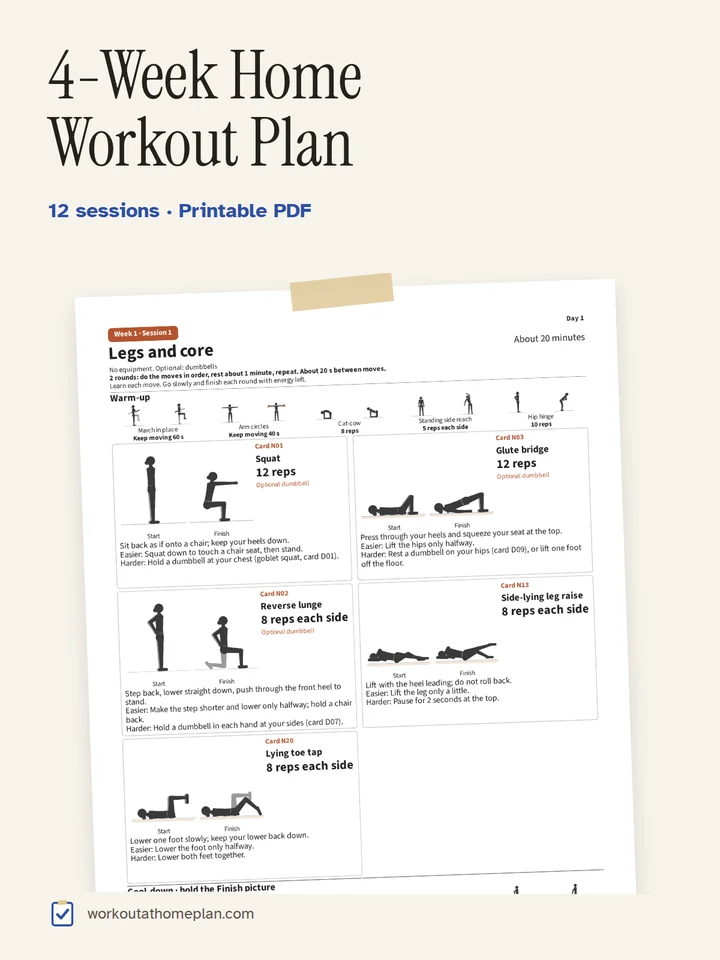
4-Week Home Workout Plan
Know exactly what to do at home for your first month: three sessions a week of about 20–30 minutes, every move pictured.
- 4 weeks
- 3 sessions a week
- about 20–30 min