
A home workout plan with no equipment
Published 2026-11-03 · Updated 2026-11-03
You can train at home with no equipment. The plan is not "do the hard version every day." Public guidelines split two jobs. Move on most days. Do muscle-strengthening on 2 or more days a week, not as a complete strength workout every morning.
The CDC adult guidelines use 30 minutes a day, 5 days a week, as one way to reach 150 minutes of moderate activity, and they say some activity is better than none. Mayo Clinic says to aim to exercise most days of the week, and to do strength work for all major muscle groups at least two times a week for about 20 to 30 minutes. Harvard Health notes a day off between complete strength workouts.
Harvard Health says to discuss a new exercise program with your doctor before you begin. Stop if anything hurts.
Seven moves a beginner can actually do
The question asks for 7 exercises. The CDC page publishes weekly minutes and muscle-strengthening days. A no-equipment page in the search results is framed as 7 no-equipment workouts, which is a count of workouts, not a medical list of daily drills. Use the seven moves below as a practical set. They need a floor, a wall, and a sturdy chair. Nothing else.
March in place. Start standing tall. Lift one knee, then the other, arms swinging. Cue: land softly. This can be the easy-day pulse, or the warm-up on a strength day.
Hip hinge. Start standing, knees soft. Push your hips back and slide your hands down your thighs, then stand tall. Cue: hinge at the hips. Do not round and yank the back.
Squat to a chair. Start standing in front of a sturdy chair, feet about hip-width. Sit your hips back until you touch the seat, then stand. Cue: heels stay down. You do not have to sit all the way and stay there.
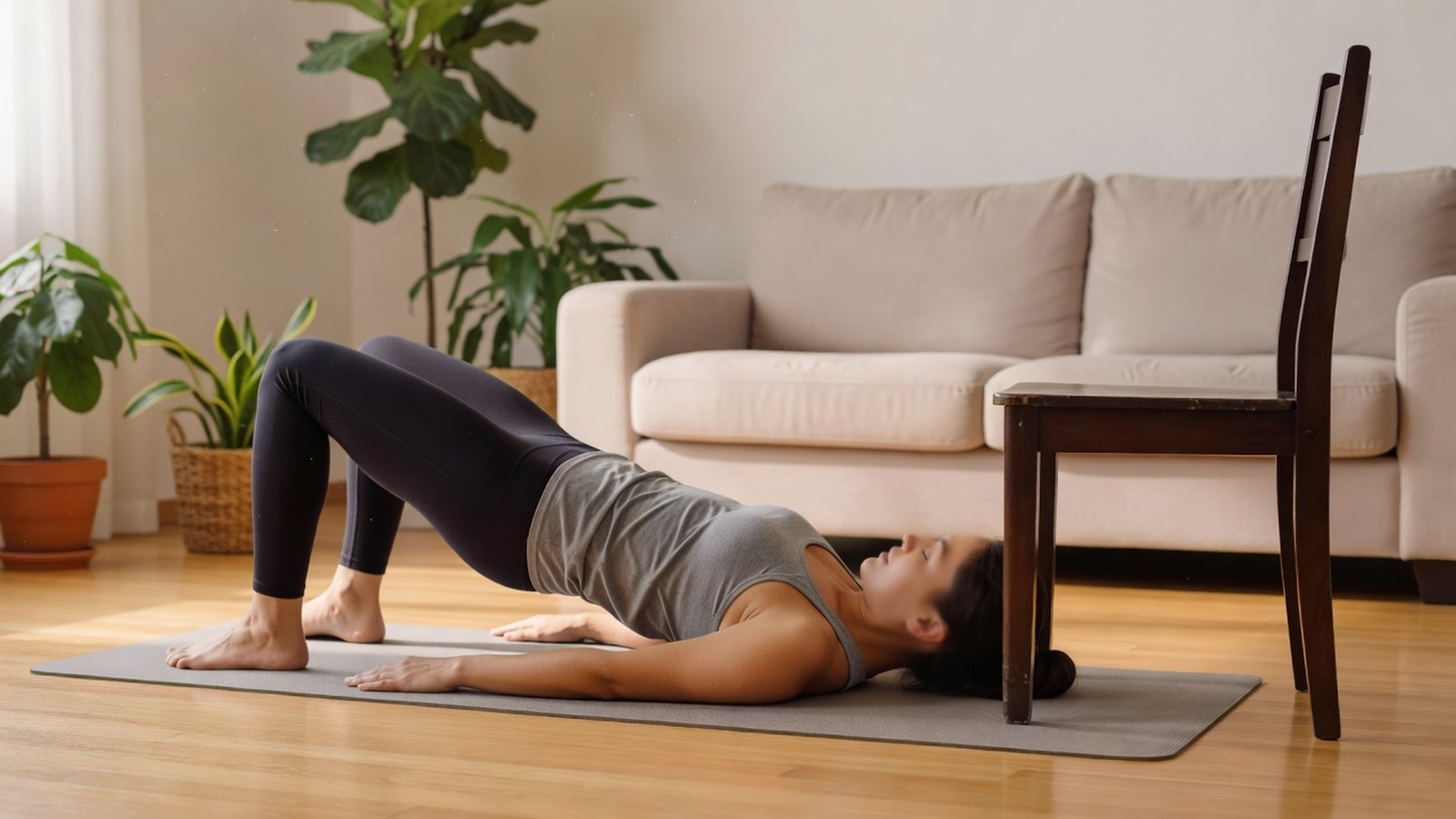
Glute bridge. Start on your back, knees bent, feet flat. Press through your heels and lift your hips a little, then lower. Cue: squeeze your seat, keep the neck quiet. On an easy day, stop halfway.
Wall push-up. Start with your hands on the wall, feet stepped back, body in one line. Bend your elbows and bring your chest toward the wall, then press away. Cue: do not let the hips sag. A lower chair seat is the harder version, only if the chair is stable and will not slide.
Bird dog. Start on hands and knees. Reach one arm forward and the opposite leg back, then switch. Cue: hips stay level. Easier: slide the foot along the floor.
Standing side reach. Start standing, feet planted. Reach one arm up and lean a little to the other side, then switch. Cue: both feet stay down. Move slowly. This is a mobility reach, not a bounce.
That is the seven. Learn the shape before you add speed. A simple 30-minute routine shows how these sit inside one session if you want the clock as well as the list.
Daily movement is not the same as a strength day
Read the two rules side by side.
Daily, or most days: aerobic movement. The CDC example is 30 minutes a day on 5 days, and it says you can break that into smaller chunks. Some activity is better than none. An easy march, a walk around the block, or the seven light versions above can live on those days.
Strength days: muscle-strengthening for the major groups on 2 or more days a week. Mayo Clinic puts that at about 20 to 30 minutes, at least two times a week, and says one set of each exercise can be enough, with a resistance that tires the muscles after about 12 to 15 repetitions. At home, with no weights, "tires the muscles" means the last reps of the squat or the push-up feel like work, not like a sprint you cannot finish.
The day off is the other half of the strength rule. Harvard Health says the American College of Sports Medicine recommends only two or three complete strength workouts a week, and to consider a day off in between. That day off is from the tiring rounds. It is not a rule that you must lie down. Light movement is fine on that day, and it counts toward the CDC's moderate weekly minutes only when it reaches a pace where you can talk, but not sing.
So "exercises I can do every day" means the light versions. It does not mean three hard rounds of squats and push-ups every morning. If yesterday's strength session still feels heavy, today is a march and a hinge, not another full round.
Harvard Health also suggests 5 to 10 minutes to warm up before a workout. On a strength day, that warm-up is the march and the hinge. On an easy day, the warm-up can be the whole session.
A week you can copy (illustrative)
This week is illustrative. The days are a sample, not a prescription. Swap a strength day for an easy day whenever you need to. Nothing is lost if you miss one.
- Day 1, strength: warm up, then one round of chair squat, glute bridge, wall or chair push-up, reverse lunge with a hand on the chair, and bird dog. Rest as you need. Cool down with the side reach.
- Day 2, easy: march, hinge, halfway bridge, wall push-up, side reach. Stop while it still feels light.
- Day 3, strength: same moves as day 1. If day 1 felt fine, add a second round.
- Day 4, easy or a walk.
- Day 5, strength: same as day 1, slow. Leave a rep in reserve.
- Day 6, easy march or a full day off the strength moves.
- Day 7, off, or the seven light moves if you want to move.
A page cannot tell you how yesterday felt. That is the limit of a copied week. If the strength day leaves you wrecked, the next day is easy. Do not "make up" a missed hard day by stacking two hard days.
Chair support, when the floor feels like a lot
The chair is a tool, not a failure. Use it like this.
Squat: the seat is the depth marker. Touch and stand. You are still doing a squat.
Push-up: hands on the wall first. When that is steady, hands on a chair seat that will not slide, body in one line, the same cue as the wall version.
Lunge: one hand on the chair back, short step back, lower a little, push through the front heel.
Bridge: no chair required. If getting to the floor is the hard part, do the hinge and the march that day and save the bridge for when the floor is easy to get down to and up from.
A band, a bench, and a downloaded timer stay optional. If you later want pictures of each shape to tape up, that is a separate choice from the plan itself.
Pictures of the moves, if you want them on paper
The seven moves above are enough to start. If you want each shape on a card you can hold, the No-Equipment Exercise Cards show each move with large Start and Finish pictures, a cue, and an easier and a harder option. The No-Equipment Exercise Cards are an instant digital download, nothing ships, and the price is $6.50. Three ready-made card sessions in the No-Equipment Exercise Cards take about 25 minutes, with a warm-up and a cool-down.
A card session is rounds of moves you do at your pace, not a timer you have to chase. Cutting is by hand.
If you want the days already ordered for a first month, the simple home routine and the how to make a workout plan page sit next to this one. A floor start that admits the pull-up bar question is the calisthenics plan. To log the days on paper, see paper or an app.
Questions
What are 7 exercises I can do every day as a beginner?
Public guidelines do not name a list of 7 daily exercises. Seven easy moves you can use on a light day are a march in place, a hip hinge, a squat to a chair, a halfway glute bridge, a wall push-up, a bird dog, and a standing side reach. Hard strength work for the same muscles is not an every-day plan.
Can a beginner do strength work every day?
Not as a complete strength workout. Muscle-strengthening belongs on 2 or more days a week in the CDC adult guidelines. Harvard Health suggests only two or three complete strength workouts a week and a day off in between. Easy marching can still happen on the other days.
What is a rest day if I do not want to sit still?
A rest day from strength can still include an easy march, a short walk, or the seven light moves. It is a day off from the tiring rounds, not a ban on moving.
From the shop
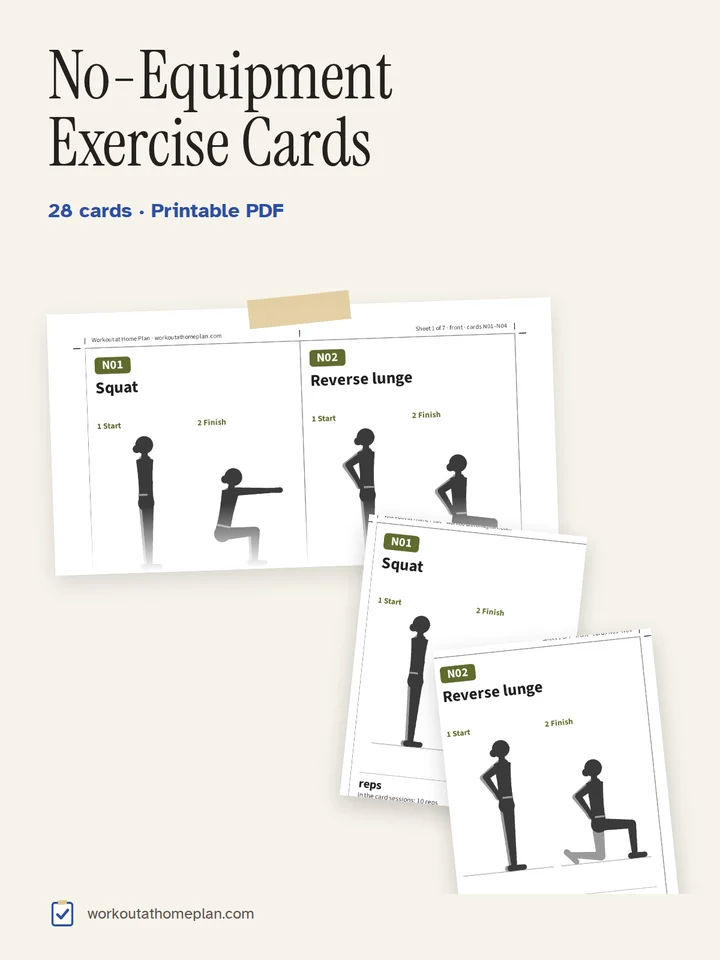
No-Equipment Exercise Cards
See each move clearly at your own pace and build a session from cards, without video.
- 28 cards
- no equipment