
Workout planner: paper, app, or wearable
Published 2026-11-03 · Updated 2026-11-03

Use paper when you want today's session on the wall and a log you fill by hand. Use an app when you want a diary and a workout list that stay on your phone. Use a wearable when you want heart rate and steps recorded for you, plus a nudge to move. You can mix them. The plan can live on paper while a band watches heart rate. Pick the method you will still open on a tired evening.
Check with your doctor before a new plan, and stop the session if it hurts; the minutes you might log come from the CDC adult activity overview, which is general guidance, not a personal medical plan.
Where each method is stronger
Paper is stronger when the session has to be visible with the phone face down. A tick on a page does not need a login, a battery, or a subscription screen. You can tape the week by the mat and see the next move without unlocking anything. Paper is weaker when you want a long history searched in seconds, or a reminder that taps your wrist while you are on the sofa.
Apps are stronger when the diary and the exercise list should stay on the phone. The first result for this search is an iPhone workout app that offers a workout diary and in-app purchases. That listing shows what that one app offers, including a diary you keep on the phone. Treat it as a vendor page about that app alone. An app is the stronger choice if you want that kind of diary and you will open it. It is the weaker choice if the plan has to be on the wall, or if the shop of workouts pulls you into browsing instead of the session.
Wearables are stronger when you want numbers recorded for you. Many wearable activity trackers can monitor your heart rate when you exercise and periodically throughout the day. You can check your heart rate with an activity tracker that includes a heart rate monitor. An activity tracker can be used to count steps, find out distance traveled, and monitor other fitness information. Some trackers display progress in real time, and that real-time information can help remind you to move more on any given day. You can look at this information later on a smartphone. That is the wearable's edge: heart rate, steps, and a nudge, then a phone if you want to review them. A basic activity tracker on its own is weaker as a plan: it records numbers, and the routine lives somewhere else. Watch apps that support workout plans can carry the routine and log sets on the wrist, so that gap closes if you use one.
A fair mix for a home week: paper for the plan and the ticks, a wearable if you care about heart rate or steps, and an app only if you will use the diary. You do not need all three.
What you are logging against is still the public week. Adults need at least 150 minutes of moderate-intensity activity a week, such as 30 minutes a day, 5 days a week, plus 2 days of muscle-strengthening activity. A log that shows those boxes, in whatever tool, is doing the job. Some physical activity is better than none, including a week with blank rows.
A page you can copy (illustrative)
Copy this layout onto a sheet, or into a note, and fill the blanks. The sample words in the first row are an illustration of how a row looks. They are not your week.
Week of: ____________

Day | Plan | Done | How it felt
Mon |  |  |
Tue |  |  |
Wed |  |  |
Thu |  |  |
Fri |  |  |
Sat |  |  |
Sun |  |  |

Session log (one block per day you train)
Date: ______   Session name: ____________
Move | Sets | Reps | Weight | Notes
____ | ____ | ____ | ______ | ____
____ | ____ | ____ | ______ | ____
____ | ____ | ____ | ______ | ____
How it felt: ____________
A filled example row, still only an illustration: Monday, legs and core, tick, "steady, left the last reps in the tank." The next Monday you write what you actually did.
Keep the planner page and the session log on the same sheet if you can. Planning without a log forgets what you lifted. A log without a plan is a diary of whatever you felt like. Both lines belong on the week page.
Set a short reset once a week, on a day you already sit at the table. Copy the next week's rows from this week's page. Tick what you did. Leave a missed day blank, and write the next session name in the next open row. That reset is the habit. A wearable can stay on the wrist during the session and stay quiet on the page. An app can stay closed if the page already names the moves.
Write the week the night before, while the kettle is on, so the morning is only the session. If the reset takes longer than making tea, the layout is too fancy. Drop a column before you drop the habit.
What to log after the session
Write four things, then stop. The date. The session name, in your own words. The moves you did, with the sets, reps, and weight if you used any. How it felt, in a few words: easy, steady, or too much.
Skip body measurements, calories, and scores you will not use. They clutter the page and they are not required to see whether you showed up. If a wearable already stored heart rate and steps, you can leave those boxes blank on paper and glance at the device later, which matches the Mayo note that tracker information can be reviewed on a phone.
If you are still deciding what the week should contain, write the plan before you worry about a fancier log. The steps for that are in how to make a workout plan. A first month of named sessions is in the beginner plan for women at home. A free week you can print is the free home workout plan.
A tracker you print
You can copy the layout above and buy nothing. The honest limit is that a blank grid does not name the moves, and a wearable will not tick the box for you.
When you want the log pages already ruled, the Home Workout Tracker is for writing down every home workout you do, ours or your own, and seeing where you are at a glance. It has 16 numbered week pages, three session blocks each, with move rows for sets, reps, weight, and notes, and how it felt. It also has a 4-week wall tick sheet and a 12-week wall tick sheet. It is $4.99. You get an instant digital download, and nothing ships. It is print-only, you fill the pages with a pen, and video, a coach, and an app sit outside the file. It logs workouts only: there are no body-weight, measurement, or calorie fields. US Letter and A4 come as separate PDFs. A printer, paper, and a pen are what you need.
If you also want the sessions named for you, the plan sits next to the log, not inside it. Start with the week on this page either way.
Questions
Should I track workouts on paper, in an app, or with a wearable?
Use paper when you want today's session on the wall and a log you fill by hand. Use an app when you want a diary and a workout list that stay on your phone. Use a wearable when you want heart rate and steps recorded for you, and a nudge to move. Many people plan on paper and let a wearable handle heart rate. Pick the one you will still use on a tired evening.
What goes on a weekly workout planner page?
A week label, seven day rows, what you plan to do, a done tick, and how it felt. Under that, a few move rows for the session you did: the move, the sets, the reps, the weight if you used one, and a note. Leave blanks. A page you can copy is in the layout section of this guide.
Can I use a paper log and a wearable together?
Yes. Paper can hold the plan and the ticks. A wearable can hold heart rate and steps, which Mayo Clinic notes many trackers can monitor during exercise and through the day. You do not have to pick only one. Skip any field you will not fill in.
From the shop
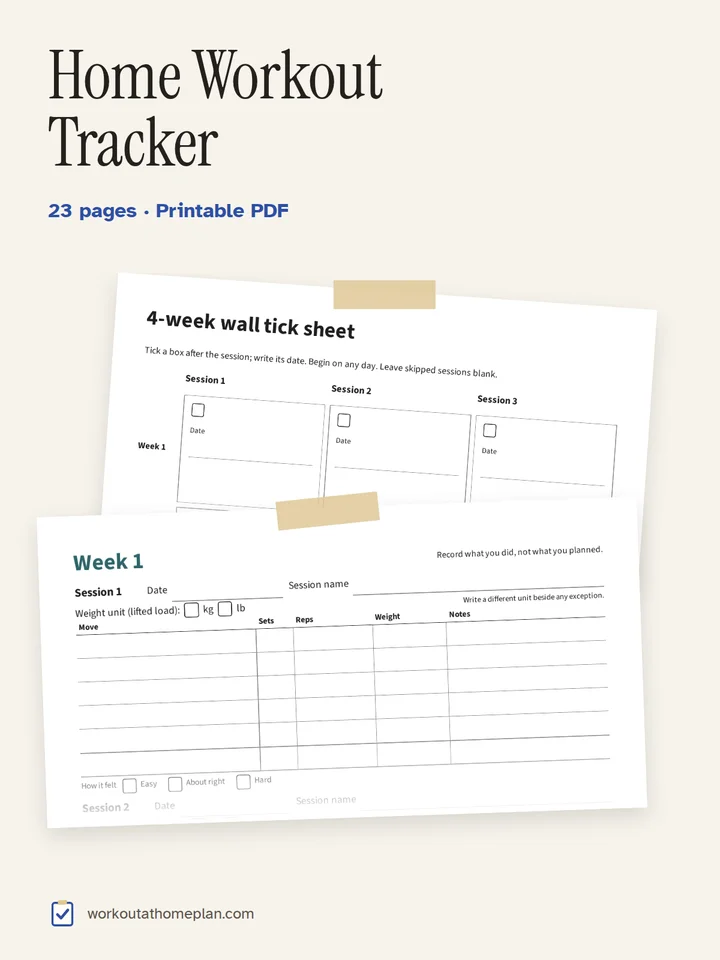
Home Workout Tracker
Write down every home workout you do, ours or your own, and see where you are at a glance.
- 16 week pages
- print and write
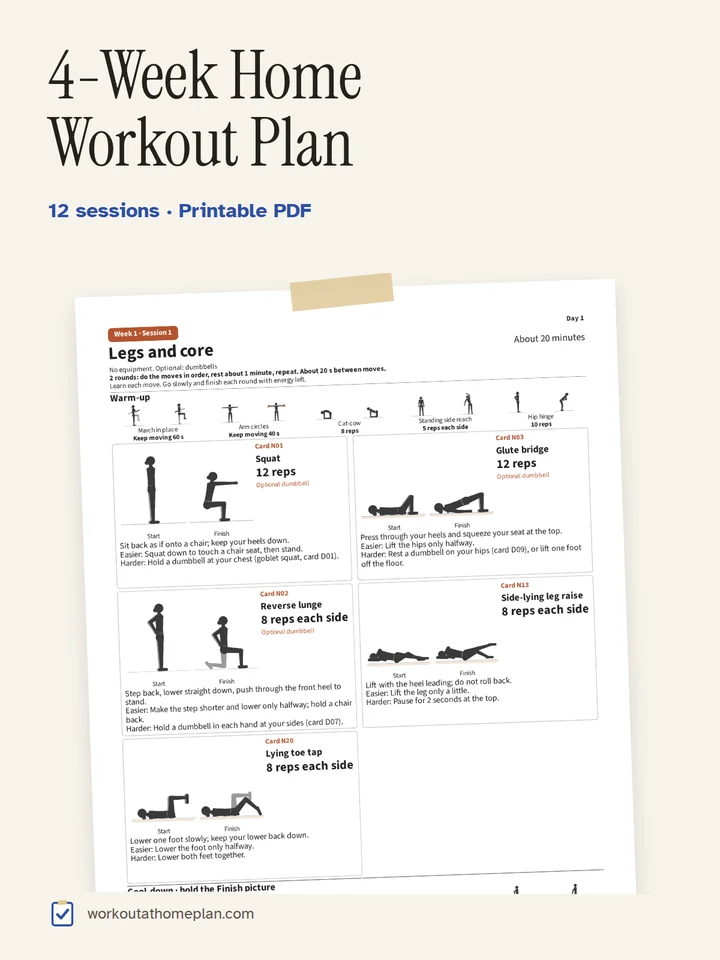
4-Week Home Workout Plan
Know exactly what to do at home for your first month: three sessions a week of about 20–30 minutes, every move pictured.
- 4 weeks
- 3 sessions a week
- about 20–30 min