
How to set a beginner HIIT workout at home
Published 2026-11-03 · Updated 2026-11-03
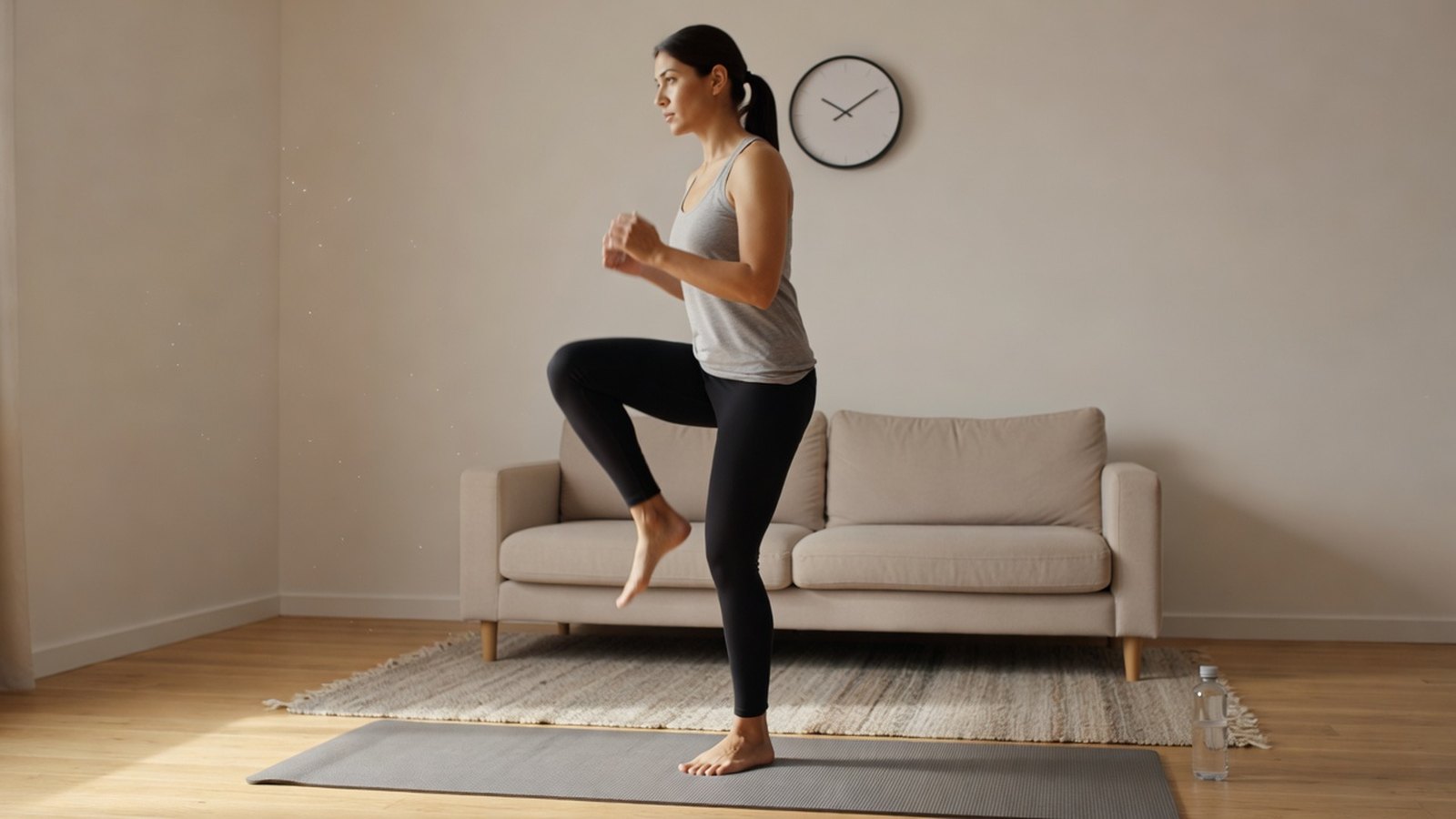
A beginner HIIT workout at home is short hard efforts with a rest that is at least as long as the work. Harvard Health describes the pattern as 30 to 90 seconds of high-intensity effort, followed by an equal or longer period of easier work or rest. A concrete example from the Mayo Clinic HIIT infographic is a 30 second harder bout and a 60 second walk, done 6 times, with a 3 min warm-up and a 3 min cool-down. That package is about 15 minutes, on 3 days a week.
If you are just starting to exercise, do not open with intervals. Mayo Clinic News Network says to wait at least two weeks before adding interval training to a new program.
Talk to your doctor before any major change in your exercise routine, and stop if anything hurts. Mayo Clinic also says to begin gradually, to avoid long high-intensity intervals at the start, and to schedule days to recover between HIIT sessions.
How to set the work and the rest
Pick the rest first. A first home session should use the longer easy period, not the shortest one you can find.
Harvard's range is 30 to 90 seconds of hard work, then an equal or longer easy period. When you are first starting, the same page says to alternate a few short hard intervals with longer easy ones. One walking example: after five minutes of ordinary walking, go faster for one minute, then ease off for three minutes, and repeat that cycle five more times. That is a one-to-three work-to-easy split inside a walk you already do. The digits are small. The idea is the long easy side.
Mayo's infographic is the version that fits a living room if you swap the sprint for a brisk march. Work 30 seconds. Easy 60 seconds. Repeat 6 times. Warm up for 3 min. Cool down for 3 min. Three of those days is the frequency on that page, with recovery days between them. Fast walking, the page says, can provide an interval stimulus. You do not have to sprint.
A third published option is equal work and rest. A beginner guide from The Body Coach suggests starting at 20 seconds on and 20 seconds off, then lengthening the hard side as it gets familiar. Equal rest fits Harvard's "equal or longer." It is a fair later step. For the first sessions at home, take Mayo's longer easy minute instead.
Some gym pages use a shorter rest. A PureGym beginner page says to start with 30 seconds of high energy movement followed by a 10 second rest. That rest is shorter than the easy period Harvard describes as equal or longer. You can see why a class uses it. You do not have to copy it in week one on the rug.
Mayo Clinic News Network gives a wider band if you already walk most days: a harder bout of 30 seconds to two minutes, then one to three minutes easier, inside a 20- to 40-minute plan. That is for someone who already has a walking habit. The two-week wait still applies if the habit is new.
The weekly picture is separate from one session. The CDC still asks for 150 minutes of moderate activity a week, or 75 minutes of vigorous activity, plus muscle-strengthening on 2 or more days. A 15-minute interval day does not replace that week. Keep easy walks on the other days if you want the moderate minutes. Intervals are the vigorous spice, not the whole plate.
How hard the hard part should feel
You do not need a heart-rate strap. The CDC talk test is enough. During moderate work you can talk, but not sing. During vigorous work you cannot say more than a few words without pausing for a breath.
On the easy interval you should get your breath back enough to talk. If you cannot, the rest is too short or the work was too hard. Lengthen the easy side. Do not shorten it to look tougher.
Harvard Health also offers a simple effort scale: aim for an 8, where 1 is very easy and 10 is as hard as you can go. An 8 is hard. It is not a collapse. If the march never gets past a chatty pace, it is not the hard interval yet. If you cannot finish the 30 seconds with a shape you still control, it was too hard. Slow the march. Keep the rest.
Lower-impact swaps
Jumping is optional. These swaps keep the clock and drop the impact.
- Hard march instead of a sprint. Mayo Clinic already names fast walking as an interval stimulus. Lift the knees a little, swing the arms, stay on the mat.
- Squat to a chair instead of a jump squat. Touch the seat and stand. Heels down.
- Hands on a sturdy chair or against the wall instead of a floor push-up. The Harvard nutrition source shows that chair and wall change for a push-up in a beginner interval example, with slow marching between efforts.
- Step-out arm reach instead of a jumping jack. Tap one foot to the side and reach up, then the other foot. No hop.
- Glute bridge instead of a burpee. On your back, feet flat, lift the hips, lower with control.
Use one or two swaps in a session, not a new move every interval. The point of the clock is the effort, not a circus of shapes.
A first session you can write on paper (illustrative)
This session is illustrative. The clock matches the Mayo example above. The move choices are a home swap, not a class you must copy. If the 30 seconds feels wild, march the whole work interval and save the squat for another day.
Warm up for 3 min with an easy march and a few hip hinges.
Then 6 rounds: 30 seconds of brisk marching or chair squats, 60 seconds of easy marching. Shake your hands if you need to. Keep the easy minute honest.
Cool down for 3 min. Slow the march. Add a gentle side reach. Stop while your breathing is coming back.
Do this on 3 days in the week, with a day between, only after you have already been moving for at least two weeks. On the other days, walk or do the easy full-body routine in the simple home workout guide. Intervals are not the plan for every day.
A written clock cannot see your form. That is the limit. If the chair squat pulls at a knee, march instead. If marching still feels wrong, stop the session.
A move reference is not a HIIT program
The printable files on this shop are not a HIIT program. A card session is rounds of moves, done at your pace, not 30 seconds on a buzzer.
If you want a picture of the squat, the bridge, the march, or the push-up, the No-Equipment Exercise Cards show each move with Start and Finish pictures, a cue, and an easier and a harder option. The No-Equipment Exercise Cards are $6.50, an instant digital download, and nothing ships. Three ready-made sessions in the No-Equipment Exercise Cards take about 25 minutes, with a warm-up and a cool-down.
Use a card to check the shape. Use a kitchen timer, if you want one, for the 30 and 60 seconds. A ready-made card session is rounds of moves, not a work-rest clock.
If timed work feels like the wrong tool, skip it. The no-equipment plan is strength and easy days without a buzzer. How to make a workout plan is the page for choosing days. A free written start, with no interval timer, is on the free home workout plan page.
Questions
How long should work and rest be for a beginner at home?
Harvard Health describes 30 to 90 seconds of hard effort, then an equal or longer easy period. A concrete start from Mayo Clinic is 30 seconds harder and 60 seconds easier, repeated 6 times, inside a session of about 15 minutes on 3 days a week. If you are new to exercise, wait at least two weeks of ordinary activity before you add intervals.
What can I do instead of jumping?
March briskly instead of sprinting. Squat to a chair instead of jumping. Put your hands on a sturdy chair or a wall instead of a floor push-up. Mayo Clinic says fast walking can be enough to make an interval. Stop if a swap still hurts.
Are the no-equipment cards a HIIT program?
No. A card session is a round of moves you do at your own pace, not a timed HIIT program. The No-Equipment Exercise Cards show each move with Start and Finish pictures so you can work at your own pace, without video. Use them as a picture of the move, not as a timer.
From the shop
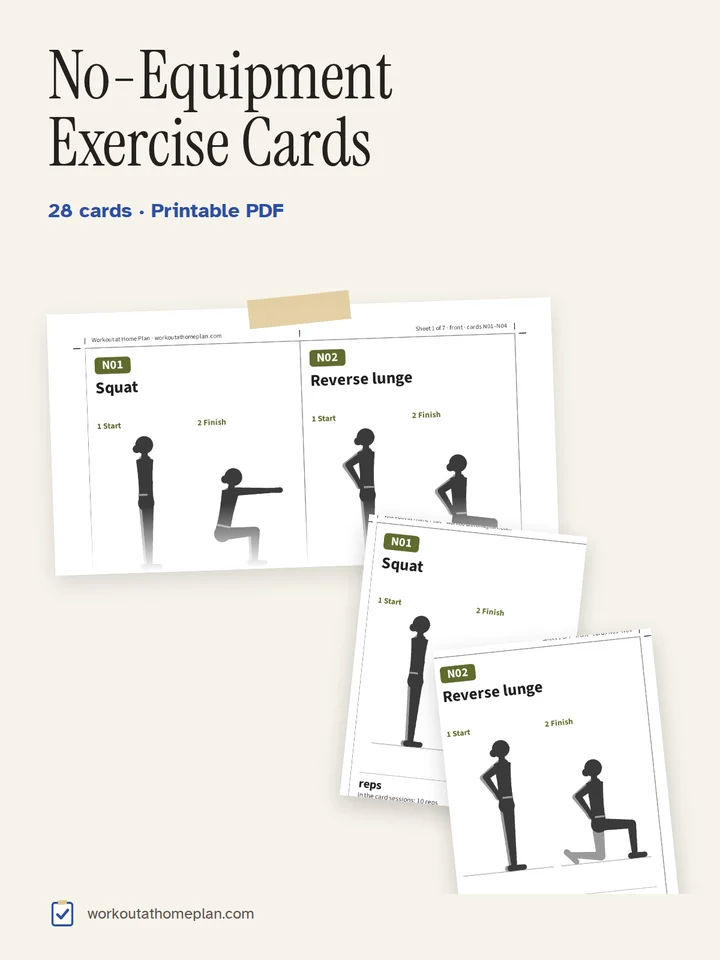
No-Equipment Exercise Cards
See each move clearly at your own pace and build a session from cards, without video.
- 28 cards
- no equipment